


Building an underground pool transforms a backyard into a private resort, but understanding the financial commitment is essential before breaking ground. The underground pool installation cost depends on multiple variables, from the pool type and size to local permitting requirements and premium features. In Los Angeles and Southern California, factors like soil conditions, access constraints, and strict building codes add layers of complexity to every estimate. Homeowners who approach the process with clear information about pricing drivers, material choices, and hidden expenses are better positioned to make confident decisions and avoid budget surprises.
Understanding the Baseline Underground Pool Installation Cost
The underground pool installation cost in 2026 typically ranges from $50,000 to over $150,000 for most residential projects, with luxury installations reaching $200,000 or more. This wide range reflects fundamental choices in construction method, size, and finish quality.
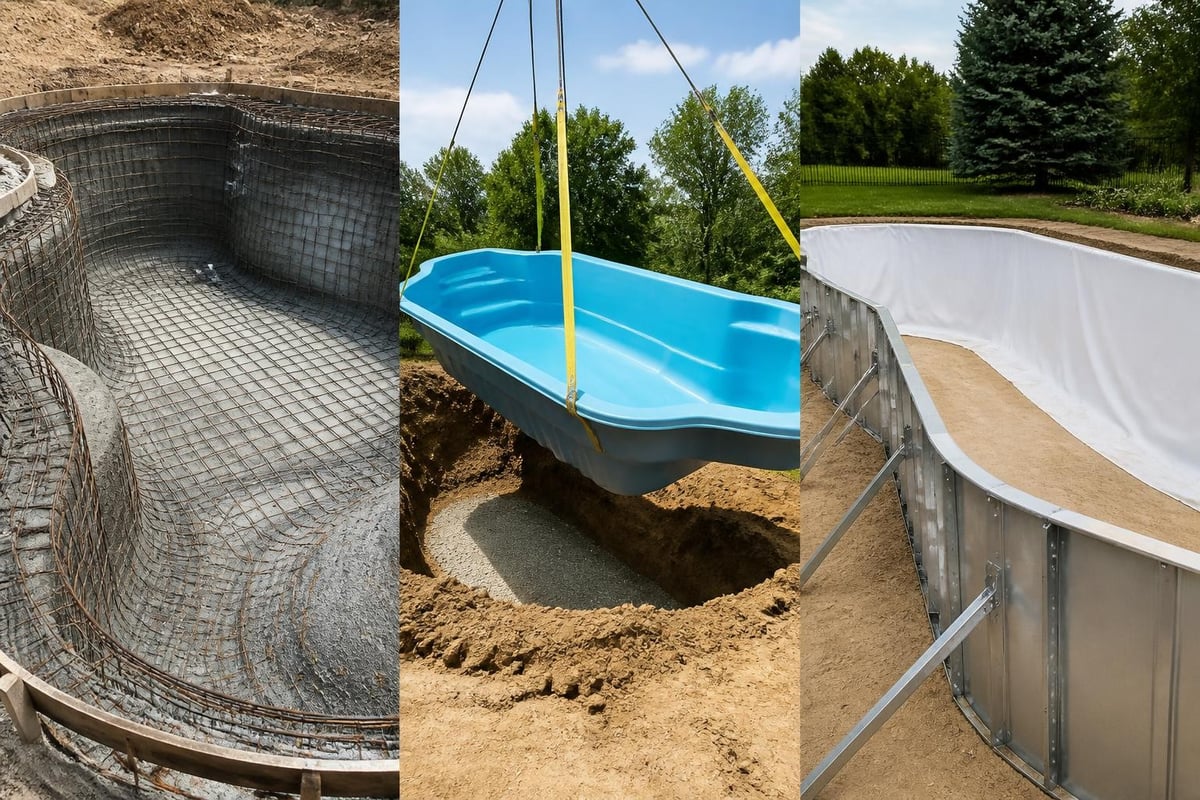
Gunite (shotcrete) pools represent the gold standard for customization and durability. These concrete pools are built on-site, allowing complete freedom in shape, depth, and integrated features. Construction costs for gunite pools generally fall between $70,000 and $120,000 for standard residential sizes (400-600 square feet), with the upper range accounting for custom shapes, integrated spas, and premium finishes. The process requires steel reinforcement, shotcrete application, plumbing, electrical work, and a finish coat of plaster or more advanced surfaces.
Fiberglass pools arrive as pre-manufactured shells and offer faster installation timelines. The underground pool installation cost for fiberglass typically ranges from $50,000 to $85,000, including excavation, crane delivery, backfill, and basic equipment. While less expensive than gunite, fiberglass pools limit shape options to manufacturer molds and restrict maximum dimensions due to transportation constraints.
Vinyl-liner pools use a steel, aluminum, or polymer panel structure with a replaceable liner. These represent the most budget-conscious option, with costs ranging from $40,000 to $70,000. However, liners require replacement every 7-12 years at $3,500-$5,000 per replacement, and the panels lack the structural permanence of concrete.
Size and Depth Impact on Total Investment
Pool dimensions directly influence excavation volume, material quantities, and equipment capacity requirements. A standard 16×32-foot pool (512 square feet) serves as the industry baseline for cost estimates, but many Los Angeles homeowners opt for larger or irregularly shaped designs.
Small pools (12×24 feet or smaller, including plunge pools and spools) range from $45,000 to $65,000 for basic gunite construction. These compact designs work well on constrained lots but still require full permitting, engineering, and equipment installation.
Medium pools (16×32 to 18×36 feet) represent the most common residential size and fall in the $70,000 to $95,000 range for straightforward rectangular designs. Adding custom shapes, beach entries, or integrated spa features pushes costs toward $110,000-$130,000.
Large pools (20×40 feet and above) start at $100,000 and quickly exceed $150,000 when incorporating multiple depth zones, extensive shallow play areas, or resort-style perimeter overflow edges. Excavation alone can exceed $15,000 for large-format pools on challenging terrain.
| Pool Size | Typical Dimensions | Base Cost Range | Best For |
|---|---|---|---|
| Small/Plunge | 10×20 to 12×24 ft | $45,000-$65,000 | Compact lots, exercise pools |
| Medium | 16×32 to 18×36 ft | $70,000-$95,000 | Standard family use, most common |
| Large | 20×40 ft and up | $100,000-$180,000 | Entertainment, multiple depth zones |
| Custom/Luxury | Varies widely | $150,000-$300,000+ | Unique shapes, integrated features |
Excavation and Site Preparation Costs
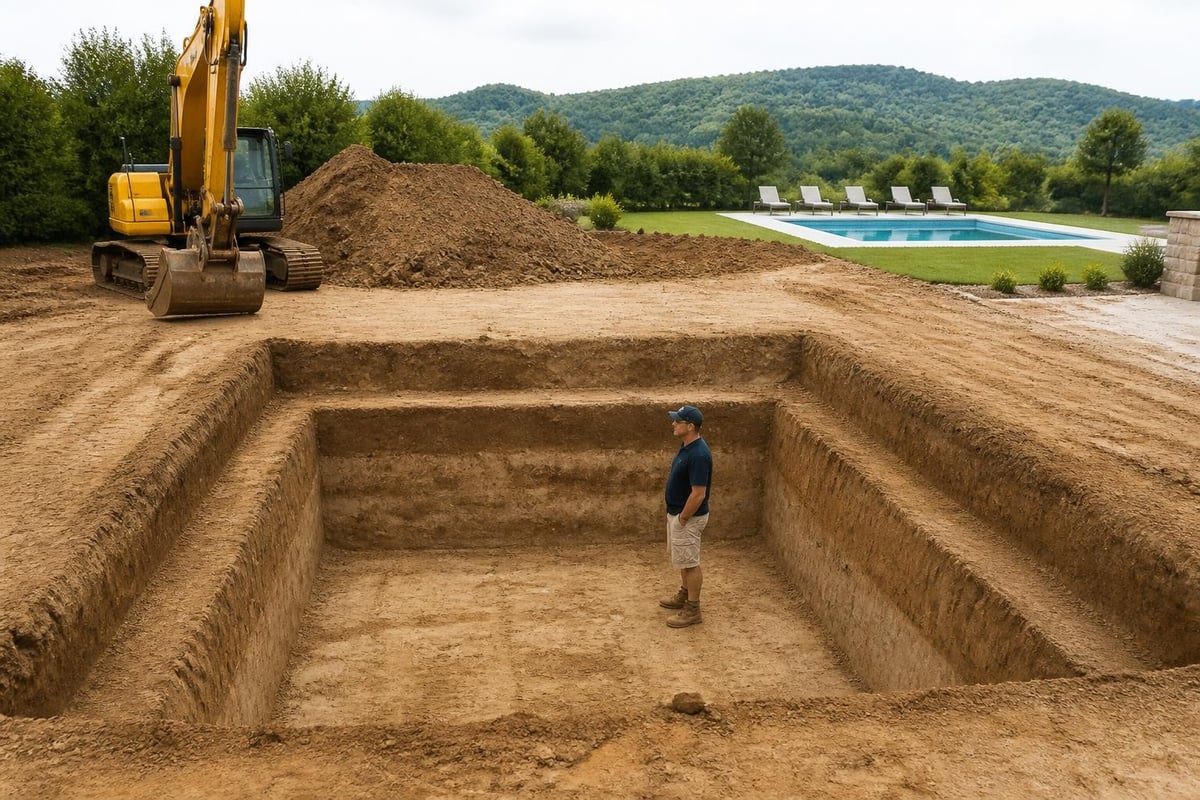
Site preparation represents one of the most variable components of underground pool installation cost. In Los Angeles, challenges like rocky soil, slopes, limited access, and utilities buried near the construction zone can double excavation expenses.
Soil Conditions and Access Constraints
Standard excavation in accessible backyards with cooperative soil runs $5,000-$10,000 for average-sized pools. This assumes equipment can enter through a standard side yard and the soil is moderate clay or sandy loam without significant rock content.
Challenging excavation scenarios add substantial costs:
- Rocky or hardpan soil: Requires hydraulic breakers or controlled blasting, adding $8,000-$15,000
- High water table: Needs dewatering systems and additional structural engineering, adding $5,000-$12,000
- Slope stabilization: Hillside lots may require retaining walls or soil nailing, adding $15,000-$40,000
- Limited access: Hand-digging or small equipment when standard excavators cannot reach the site, adding $10,000-$25,000
Los Angeles building codes require soil compaction testing and engineering approval for pools on slopes or with questionable bearing capacity. Geotechnical reports cost $1,500-$3,500 but prevent costly structural failures.
Utility relocation is frequently overlooked in initial budgets. Gas lines, electrical service, irrigation systems, and septic fields may require professional rerouting at $2,000-$8,000 depending on complexity. Always request utility location services before excavation begins. For the barrier itself, our guide to swimming pool fence installation covers code-compliant materials and costs for Los Angeles homeowners.
Permitting and Engineering Requirements
Los Angeles County and city jurisdictions maintain strict pool construction regulations that directly affect underground pool installation cost. Permitting expenses and compliance requirements vary by municipality but follow consistent patterns.
Building Permits and Inspections
Basic building permits for residential pools in LA typically cost $1,200-$2,500, covering plan review, multiple inspections during construction, and final approval. The permitting process requires:
- Engineered structural drawings stamped by a California-licensed engineer
- Electrical plans for bonding, grounding, and equipment connections
- Plumbing plans showing waste lines, fill connections, and backflow prevention
- Barrier and safety compliance documentation per the International Swimming Pool and Spa Code
Engineering costs for structural design, soil analysis, and stamped drawings run $2,000-$5,000 for standard pools. Complex sites with retaining walls, cantilevered decks, or unusual shapes can reach $8,000-$12,000 in engineering fees.
Inspection schedule typically includes:
- Pre-excavation meeting and layout approval
- Steel reinforcement inspection before shotcrete
- Rough plumbing and electrical inspection
- Bond and equipment inspection
- Barrier/fence compliance inspection
- Final completion inspection
Each failed inspection that requires rework and re-inspection adds $200-$500 in contractor time and re-inspection fees.
Safety Barrier and Fence Requirements
California law mandates pool barrier systems to prevent child drowning accidents. Compliance costs range from $3,000 to $15,000 depending on the chosen barrier type:
- Pool fence (removable mesh or permanent wrought iron): $3,000-$8,000 for perimeter installation
- Property fence upgrade: If using existing perimeter fencing, gate upgrades and self-closing hardware cost $1,500-$3,000
- Door alarms and window locks: Required when house doors provide pool access, $400-$1,200
- Pool covers (automatic safety covers meeting ASTM standards): $8,000-$15,000 for trackless systems
When working with AM Builds Inc. on custom in-ground pool construction, all permitting, engineering, and barrier compliance is handled as part of the comprehensive service, ensuring every installation meets Los Angeles code requirements without homeowner hassle.
Pool Shell Construction and Materials
The structural shell represents the largest single expense in underground pool installation cost. Material selection and construction method determine both initial investment and long-term durability.
Gunite and Shotcrete Application
Gunite construction involves spraying a concrete mixture over steel reinforcement at high velocity. This process creates an exceptionally strong, monolithic shell that can be formed into any shape. The typical cost breakdown includes:
- Steel reinforcement: $4,000-$8,000 for rebar cages tied to engineering specifications
- Shotcrete/gunite application: $15,000-$25,000 for material and specialized labor
- Structural engineering: Included in earlier permitting costs but affects shell thickness and rebar density
The gunite shell alone accounts for roughly $25-$35 per square foot of pool surface, not including excavation or finishes. A 500-square-foot pool requires 20-30 cubic yards of concrete at $200-$250 per yard, plus skilled nozzle operators at $75-$95 per hour.
Curing time for gunite requires 28 days to reach full strength, though finish work can begin after 7-10 days. Proper curing prevents cracking and ensures the shell will withstand decades of hydrostatic pressure and seasonal ground movement.
Alternative Shell Construction Methods
Fiberglass shells eliminate on-site concrete work but require careful site preparation and precise leveling. The shell itself costs $20,000-$35,000, with delivery and crane placement adding $3,000-$6,000. Backfill must be carefully controlled to prevent shell distortion before water fills the pool.
Vinyl liner pools use panelized walls (typically steel or polymer) set on a concrete footer. Wall panels cost $8,000-$15,000, with the vinyl liner adding $3,000-$5,000. While initial costs are lower, the limited lifespan of vinyl liners increases lifetime ownership costs.
Plumbing and Equipment Installation
Pool circulation, filtration, and sanitation systems represent a significant portion of underground pool installation cost, and equipment choices affect both upfront investment and ongoing operating expenses.
Core Equipment Requirements
Filtration systems remove debris and maintain water clarity. Three main types serve residential pools:
- Sand filters: $400-$800 for the filter, simplest maintenance, adequate for most pools
- Cartridge filters: $600-$1,200 for the filter, better filtration, no backwashing required
- DE (diatomaceous earth) filters: $800-$1,500 for the filter, finest filtration, more maintenance intensive
Pump selection dramatically impacts energy costs. Federal regulations now require variable-speed pumps for most new installations, as detailed in the Department of Energy’s pool pump motor standards. Variable-speed pumps cost $800-$1,800 compared to $400-$700 for legacy single-speed models, but they reduce energy consumption by 60-75%, paying for themselves within 2-3 years.
Heaters extend the swimming season and add $2,500-$6,000 to underground pool installation cost:
- Gas heaters: $2,500-$4,000, fast heating, higher operating costs
- Heat pumps: $3,500-$6,000, energy-efficient, slower heating, best for moderate climates
- Solar heating: $3,000-$7,000, zero operating cost after installation, requires significant roof or yard space
Automation and Control Systems
Basic controls with mechanical timers and manual valves cost $500-$1,200. Mid-level automation with digital controls for pump scheduling, heating, and lighting runs $1,500-$3,000. Premium automation systems with smartphone apps, remote monitoring, and voice control integration cost $3,500-$7,000 but provide convenience and energy optimization.
Salt chlorine generators automate sanitization and eliminate manual chlorine addition. These systems cost $1,200-$2,500 installed and reduce long-term chemical expenses while providing gentler water quality.
| Equipment Category | Budget Option | Mid-Range | Premium | Operating Impact |
|---|---|---|---|---|
| Pump | Single-speed $400-$700 | Variable-speed $800-$1,200 | VS with automation $1,500-$1,800 | Energy: $200-$800/year |
| Filter | Sand $400-$800 | Cartridge $600-$1,200 | DE $800-$1,500 | Maintenance time varies |
| Heater | None (seasonal use) | Gas $2,500-$4,000 | Heat pump $3,500-$6,000 | Gas: $150-$400/month when heating |
| Sanitization | Manual chlorine $0 | Salt system $1,200-$2,000 | UV + ozone $3,000-$5,000 | Chemical costs vary widely |
Interior Finishes and Surface Options
The pool interior finish affects aesthetics, maintenance requirements, and long-term durability. Surface selection significantly influences underground pool installation cost, with options ranging from basic plaster to premium aggregates and tile.
Plaster and Aggregate Surfaces
White plaster represents the traditional and most affordable finish at $3,000-$5,000 for a standard pool. This cement-based surface lasts 7-12 years with proper chemistry and provides a classic bright-blue water appearance. However, white plaster requires careful pH management and is prone to staining in areas with hard water.
Colored plaster adds pigments for gray, blue, or earth tones at $4,000-$6,500. The additional cost buys improved aesthetics and slightly better stain resistance.
Exposed aggregate finishes (pebble or quartz) cost $7,000-$12,000 but deliver 15-20 year lifespans and superior durability. These surfaces embed small pebbles or quartz crystals in a cement matrix, creating texture that resists staining, etching, and algae growth. Popular brands include Pebble Tec, Pebble Sheen, and various quartz formulations.
Glass bead and polished aggregate finishes represent the premium tier at $10,000-$18,000. These surfaces offer exceptional smoothness, brilliant color, and ultra-long lifespans of 20+ years.
Tile Accents and Waterline Treatment
Waterline tile prevents staining at the water surface and adds visual appeal. Standard 6-inch waterline tile costs $15-$30 per linear foot installed ($2,000-$4,000 for typical pools). Glass tile upgrades run $35-$75 per linear foot ($4,500-$9,000), while custom mosaic designs can exceed $100 per linear foot.
Full-tile pools with glass or ceramic tile covering all interior surfaces cost $25,000-$60,000 for materials and installation, reserved for luxury projects with unlimited budgets.
Decking and Surrounding Hardscape
The pool deck represents the transition between pool and landscape while providing essential space for furniture, entertaining, and safe entry. Decking choices substantially affect total underground pool installation cost and long-term satisfaction.
Concrete Decking Options
Broom-finish concrete provides the most economical solution at $8-$12 per square foot installed. This textured surface offers slip resistance and durability but limited aesthetic appeal.
Stamped and colored concrete simulates stone, brick, or tile patterns at $12-$20 per square foot. Multiple color options and pattern stamps create attractive surfaces that resist fading and cracking when properly installed with control joints and rebar reinforcement.
Cool-deck and textured coatings add specialized topical treatments to concrete for comfort in direct sun. These acrylic-based surfaces cost $3-$6 per square foot over base concrete and reflect heat to reduce surface temperature by 20-30 degrees.
A 500-square-foot pool typically requires 400-800 square feet of surrounding deck, adding $5,000-$16,000 to underground pool installation cost depending on the chosen material and complexity.
Premium Decking Materials
Travertine and natural stone pavers deliver exceptional aesthetics and heat resistance at $18-$35 per square foot installed. These materials stay cool underfoot, resist fading, and improve property value, though they require professional installation with proper base preparation.
Porcelain pavers offer stone appearance with improved durability and stain resistance at $15-$28 per square foot. Modern manufacturing produces realistic stone textures with superior performance characteristics.
For homeowners considering hardscape and landscape design services, coordinating pool construction with comprehensive paver installation ensures unified design, proper drainage, and efficient project completion.
Electrical Requirements and Lighting
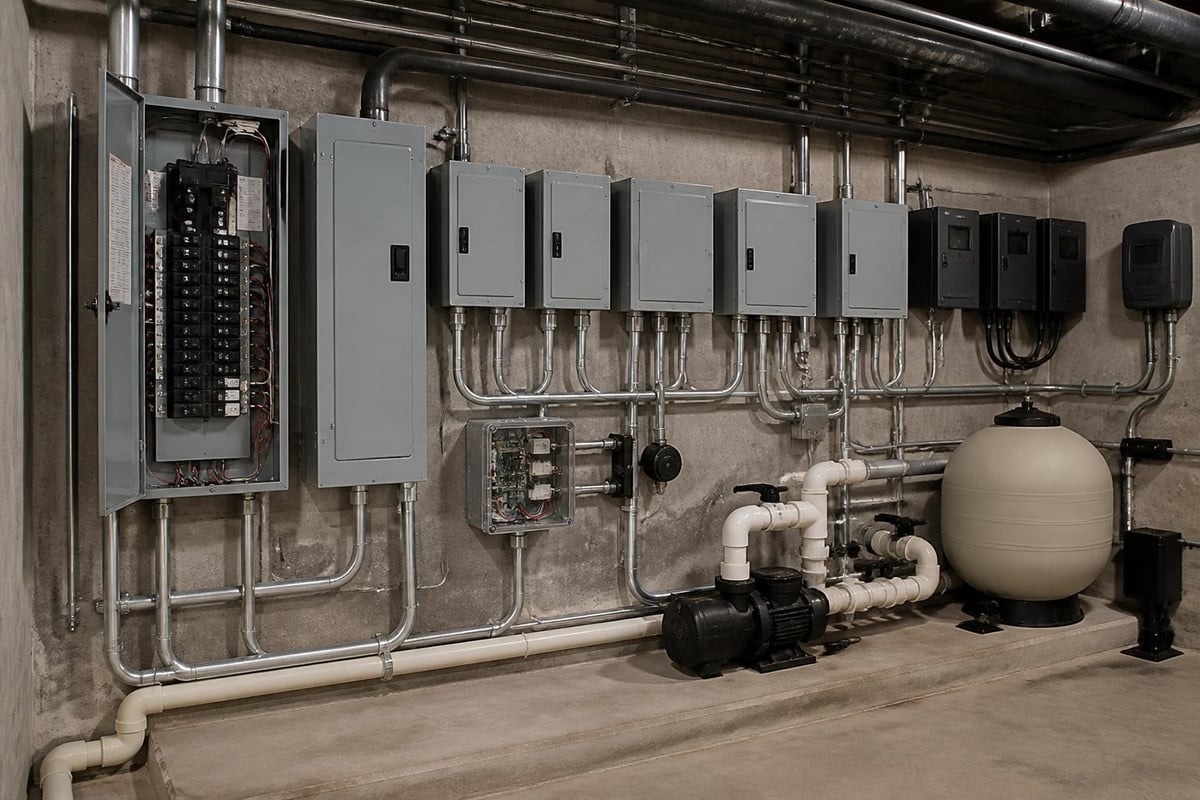
Pool electrical systems must meet rigorous safety codes for bonding, grounding, and GFCI protection. Electrical work accounts for $4,000-$12,000 of underground pool installation cost depending on equipment count and lighting complexity.
Service Capacity and Wiring
Most pool installations require electrical service upgrades from 100-amp to 200-amp panels, particularly when adding heaters, automation, and multiple pumps. Panel upgrades cost $2,000-$4,000 through licensed electricians.
Underground conduit runs from the main panel to the pool equipment pad typically span 30-100 feet. Heavy-duty wire and conduit for pump, heater, and controls cost $8-$15 per linear foot installed, plus dedicated breakers and disconnect switches.
Bonding and grounding requirements are extensive and non-negotiable. All metal within five feet of the pool water must be electrically bonded together, including:
- Reinforcing steel in the pool shell
- Ladder and handrail anchors
- Light niches and junction boxes
- Equipment enclosures and pumps
- Metal fence posts and gates
Professional electricians charge $2,000-$4,000 for complete bonding systems that pass inspection.
Pool Lighting Systems
Incandescent pool lights are largely obsolete but cost $300-$500 per light for budget installations. LED pool lights have become the standard at $600-$1,200 per light installed, offering color-changing capabilities, 50,000+ hour lifespans, and 75% energy savings. Most pools use 2-4 lights depending on size.
Fiber optic systems create ambient perimeter lighting at $2,500-$6,000 for complete installations. Accent lighting for landscaping, steps, and water features adds $1,500-$4,000 to comprehensive lighting designs.
Premium Features and Custom Additions
Luxury features transform basic pools into resort-style retreats but significantly increase underground pool installation cost. Understanding pricing for popular upgrades helps homeowners prioritize investments.
Water Features and Visual Elements
Waterfalls and rock features range from simple sheer descents at $2,500-$6,000 to elaborate natural stone grottos at $15,000-$45,000. The cost reflects materials (natural stone vs. artificial rock), height, water volume, and integrated lighting.
Deck jets and laminar flows create arcing water streams. Simple deck jets cost $400-$800 each installed, while color-changing LED laminar jets run $1,200-$2,000 each. Most installations use 3-6 jets.
Bubblers and umbrella fountains in shallow play areas cost $800-$1,500 per feature. Rain curtains and weeping walls for modern aesthetic designs run $5,000-$15,000 depending on scale.
Fire features (fire bowls, fire pits, or fire walls) combine water and flame for dramatic evening ambiance. Gas-fired fire bowls cost $1,500-$4,000 each installed, while elaborate fire and water walls can exceed $20,000.
Spa Integration and Swim Features
Attached spas share equipment with the main pool and add $15,000-$35,000 to underground pool installation cost. This includes excavation, additional shotcrete, jet systems, blower, separate heater controls, and spillway construction. The spa-pool interface can feature simple spillovers or elaborate infinity edges.
Tanning ledges (baja shelves) provide shallow lounging areas and work well for young children. These integrated features add $4,000-$12,000 depending on size and whether they include built-in seating or umbrella sleeves.
Swim jets and resistance systems turn pools into exercise facilities. Basic single-jet systems cost $3,000-$6,000, while powerful multi-jet systems for serious training run $10,000-$25,000 installed.
Automation and Energy Efficiency
Variable-speed pumps, now standard under federal rules detailed in 10 CFR §431.485, reduce energy consumption by adjusting motor speed to actual filtration needs rather than running full-power constantly.
Solar heating systems eliminate ongoing heating costs after installation. Panel arrays covering 50-100% of pool surface area cost $3,000-$7,000 installed and integrate with existing gas or heat pump systems for hybrid operation.
Automated covers provide safety, heat retention, and debris protection. Track-mounted covers cost $8,000-$15,000, while trackless systems that hide below coping run $12,000-$22,000. Energy savings from reduced evaporation and heat loss can reach $1,000-$2,000 annually in moderate climates.
Regional Cost Factors in Los Angeles
Geographic location significantly affects underground pool installation cost. Los Angeles presents unique pricing considerations compared to national averages.
Labor Rates and Contractor Availability
Los Angeles construction labor rates run 15-25% above national averages. Licensed pool contractors charge $85-$140 per hour for skilled labor, with specialized trades (licensed electricians, plumbers) at $120-$165 per hour. According to PHTA market research, California represents one of the highest-cost markets for pool installation due to regulatory complexity, labor rates, and material transportation.
Project duration in Los Angeles typically spans 10-16 weeks from permit submission to final inspection, with 8-12 weeks of active construction. Delays for inspections, material delivery, or weather can extend timelines and increase carrying costs for contractors, which may be passed to homeowners.
Soil and Site Challenges
Expansive clay soils common in many LA neighborhoods require additional engineering and may necessitate deeper footings or post-tension systems, adding $5,000-$15,000 to underground pool installation cost.
Seismic considerations mandate specific rebar configurations and structural details. While these requirements are built into standard engineering in California, they increase material costs by 10-15% compared to non-seismic regions.
Water table management in coastal and low-lying areas requires dewatering during construction and sometimes permanent drain systems, adding $3,000-$10,000 to projects.
Hidden Costs and Budget Considerations
Comprehensive budgeting for underground pool installation cost requires accounting for expenses beyond the core construction contract.
Pre-Construction and Planning Expenses
- Design and planning: Professional pool designers charge $2,000-$8,000 for custom plans, 3D renderings, and material specifications
- Soil testing and geotechnical reports: $1,500-$3,500 for sites with questionable stability
- Survey and property line verification: $500-$1,500 to ensure pool placement complies with setback requirements
- HOA approval and architectural review: $200-$1,000 in application fees for communities with design oversight
During-Construction Add-Ons
Change orders represent the most common budget overrun. Homeowners who modify plans during construction face premium pricing for redesign and rework. Changing pool shape, depth, or features after steel installation can add 15-30% to affected components.
Utility conflicts discovered during excavation require immediate resolution. Relocating gas lines, electrical service, or irrigation systems costs $2,000-$8,000 depending on scope and utility provider involvement.
Access damage and restoration affects properties where heavy equipment must cross lawns, driveways, or landscaping. Budget $1,500-$5,000 for lawn restoration, irrigation repair, and hardscape patching.
Post-Construction Expenses
Landscaping restoration around the pool area costs $3,000-$15,000 for replanting, sod installation, and irrigation system expansion. Many homeowners invest in comprehensive landscape upgrades to match their new pool, potentially doubling this figure.
Furniture and accessories turn the pool into usable outdoor space. Budget $2,000-$10,000 for lounge chairs, umbrellas, pool toys, cleaning equipment, and chemical testing supplies.
Initial chemical balance and water treatment startup costs $200-$500, including water delivery (if filling from trucks rather than house water) and initial chemical adjustments.
Insurance adjustments typically increase homeowner's insurance by $25-$75 monthly due to added liability. Some insurers require specific safety measures or higher liability limits.
Financing Options and Tax Implications
Understanding payment structures and tax treatment helps homeowners manage the financial aspects of underground pool installation cost.
Payment Schedules and Financing
Licensed contractors typically structure payments in milestone-based installments:
- Deposit: 10-20% at contract signing
- Excavation complete: 20-25%
- Steel and plumbing rough-in: 20-25%
- Shotcrete application: 15-20%
- Equipment installation: 10-15%
- Final completion: 10-15%
Home equity loans and HELOCs provide the most common financing for pools, offering tax-deductible interest (consult tax professionals) and competitive rates. Pool-specific financing through contractors or third-party lenders typically carries higher interest rates (7-12% APR) but may offer promotional terms.
Tax Considerations
Pool construction generally qualifies as a capital improvement that increases property basis rather than a deductible expense. According to IRS Publication 530, pools add to the home's cost basis, reducing capital gains tax when the property sells.
Medical necessity exceptions occasionally allow partial deductions when pools are prescribed for specific conditions (arthritis therapy, physical rehabilitation). This requires detailed documentation from physicians and typically applies only to installation costs directly related to the medical need.
Energy-efficient equipment like variable-speed pumps and solar heating may qualify for state or utility rebates. California's SGIP and other programs occasionally offer incentives for pool equipment, though these programs change frequently.
Comparing Estimates and Selecting Contractors
Gathering multiple bids helps establish realistic expectations for underground pool installation cost and identifies contractors offering the best value.
What to Request in Written Estimates
Comprehensive bids should detail:
- Complete scope of work with specific materials, brands, and model numbers
- Itemized cost breakdown separating excavation, shell, equipment, finishes, and decking
- Permit and engineering costs clearly stated
- Payment schedule tied to completion milestones
- Timeline with start and estimated completion dates
- Warranty coverage for structure, equipment, and finishes
- Exclusions listing what's not included (landscaping, furniture, etc.)
Suspiciously low bids often omit essential items, use inferior materials, or come from unlicensed contractors who won't secure proper permits. A comprehensive estimate from a licensed professional like AM Builds Inc. provides clarity and confidence that every aspect of construction meets code and quality standards.
Verifying Credentials and References
California requires pool contractors to hold appropriate CSLB licenses (C-53 for swimming pool construction). Verify:
- Active license status through CSLB online lookup
- Workers' compensation insurance protecting employees and homeowners
- General liability insurance at minimum $1 million per occurrence
- Recent project references with contact information for past clients
- Photo portfolio showing completed work similar to your project
Online reviews on Google, Yelp, and industry sites provide additional perspective, though homeowners should weigh recent reviews more heavily than older feedback.
Long-Term Ownership and Operating Costs
Understanding ongoing expenses helps evaluate true lifetime underground pool installation cost and informs decisions about equipment and design.
Annual Maintenance and Chemical Expenses
Chemical treatment costs $400-$1,200 annually depending on pool size, usage patterns, and water chemistry. Salt systems reduce chemical needs but require periodic salt addition and cell replacement every 3-5 years ($600-$1,000).
Professional maintenance service runs $100-$200 monthly for weekly cleaning, chemical testing, and equipment inspection. DIY maintenance reduces costs but requires time investment and knowledge.
Equipment repairs and replacement average $500-$1,500 annually for pumps, filters, heaters, and automation systems. Major component failures (pump replacement, heater repair, filter replacement) occur every 8-12 years.
Energy Costs and Efficiency
Unheated pools with variable-speed pumps cost $30-$80 monthly in electricity for filtration and circulation. Heated pools using gas heaters add $150-$400 monthly during heating season (November through April in Los Angeles). Heat pumps reduce this to $80-$150 monthly with longer heating cycles.
Solar heating eliminates heating costs after installation but requires pump operation to circulate water through panels, adding $20-$40 monthly in pump electricity.
Pool covers reduce evaporation by 90-95%, cutting heating costs by 50-70% and reducing chemical consumption by 30-40%. The savings often justify the $8,000-$15,000 investment within 4-7 years.
Resurfacing and Major Renovation
Plaster resurfacing becomes necessary every 8-15 years at $4,000-$7,000 for standard white plaster or $8,000-$14,000 for aggregate finishes. Tile replacement costs $20-$40 per square foot. Equipment upgrades to modern, efficient systems cost $8,000-$15,000 every 12-18 years.
Homeowners considering comprehensive updates to aging pools can explore pool remodeling options that transform outdated designs into modern outdoor living spaces.
Understanding underground pool installation cost empowers homeowners to make informed decisions about materials, features, and contractors while building realistic budgets that account for both construction and long-term ownership. Working with a licensed, experienced contractor who handles every aspect from design through permits, construction, and final inspection ensures your investment delivers lasting value. AM BUILDS CA brings 15+ years of custom pool construction expertise to Los Angeles homeowners, managing complete projects with transparent pricing and direct owner involvement. Contact us at (424) 485-4548 for a free, no-obligation estimate on your backyard transformation.


