


Transforming your backyard with a custom swimming pool and surrounding deck represents one of the most significant investments a homeowner can make. Pool and deck installation involves far more than excavating a hole and pouring concrete-it requires careful coordination of engineering, permitting, construction sequencing, and material selection to create a functional outdoor living space that will last decades. In Los Angeles and similar metropolitan areas, homeowners face unique challenges including strict building codes, water conservation requirements, and soil conditions that demand experienced contractors who understand both the technical and aesthetic dimensions of this complex project.
Understanding the Pool and Deck Installation Process
The journey from concept to completion follows a predictable sequence, though timelines and specific steps vary based on property conditions, pool design, and local requirements. Most residential projects span three to six months from permit application to final inspection.
Initial Planning and Design
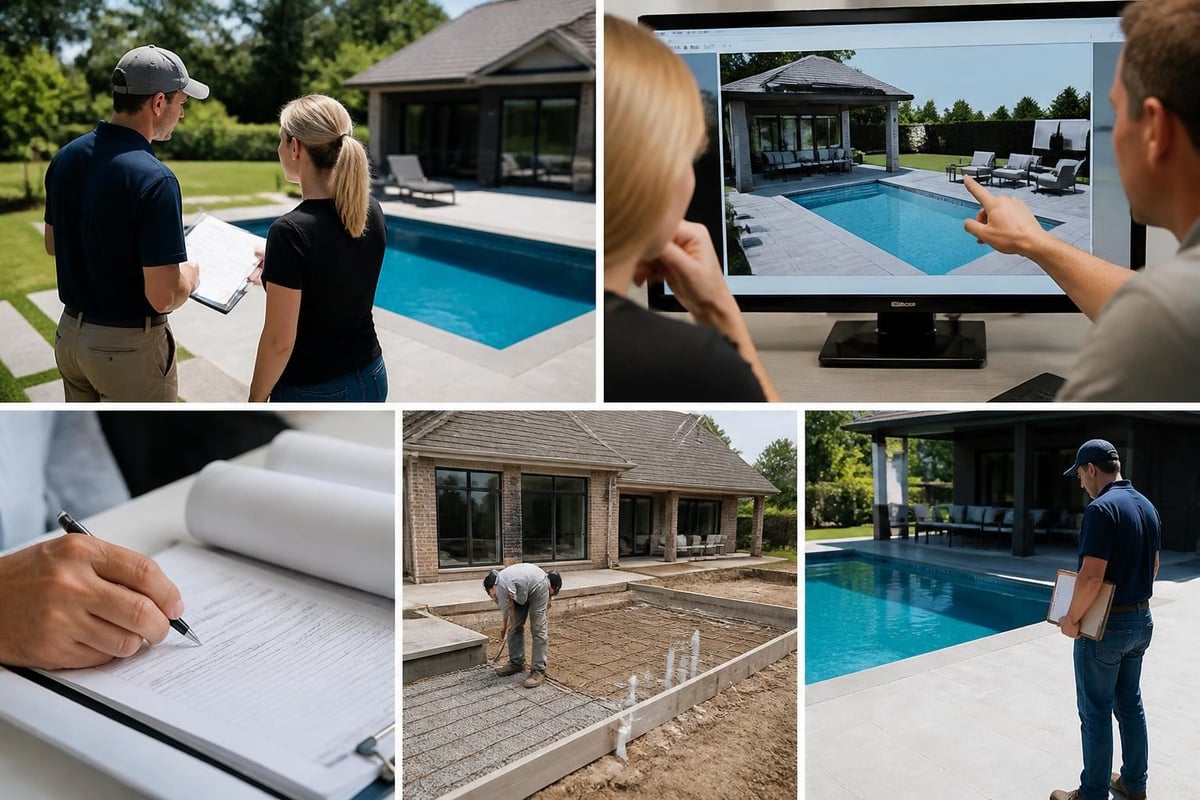
Before breaking ground, homeowners work with their contractor to translate vision into detailed plans. This phase establishes pool dimensions, shape, depth, equipment locations, and deck layout. Custom design considerations include:
- Lot topography and drainage patterns
- Setback requirements from property lines
- Underground utility locations (gas, electric, water, sewer)
- Existing landscape features worth preserving
- Access points for equipment and future maintenance
Professional contractors conduct soil testing to identify expansive clay, groundwater levels, or bedrock that might affect construction methods. In Los Angeles County, proximity to hillsides or fault zones may trigger additional engineering requirements. The swimming pool planning phase sets the foundation for everything that follows.
Permits and Engineering
Every pool and deck installation in California requires building permits, and the process involves multiple agencies. Permit requirements typically include:
- Building department approval for structural plans
- Health department review of circulation and sanitation systems
- Energy compliance documentation (Title 24)
- Electrical permits for bonding, grounding, and lighting
- Grading permits if significant earth movement occurs
The International Swimming Pool & Spa Code provides model standards that many California jurisdictions adopt with local modifications. Engineers stamp structural plans showing steel reinforcement, shell thickness, and deck support details. Electrical plans must comply with National Electrical Code requirements for bonding all metal components within five feet of water.
Permit timelines range from three weeks to three months depending on jurisdiction workload and plan complexity. Experienced contractors submit complete, code-compliant plans that minimize revision cycles and delays.
Pool Shell Construction Methods
The pool structure itself can be built using several construction methods, each with distinct advantages and installation sequences that affect the overall pool and deck installation timeline.
Gunite and Shotcrete Pools
Gunite (dry-mix) and shotcrete (wet-mix) represent the most popular methods in Southern California, offering maximum design flexibility. After excavation, contractors install steel reinforcement bars in a grid pattern, then pneumatically spray concrete over the rebar cage.
| Construction Aspect | Gunite | Shotcrete |
|---|---|---|
| Mix application | Dry materials, water at nozzle | Pre-mixed with water |
| Compressive strength | 4,000-6,000 PSI | 4,000-6,000 PSI |
| Waste/rebound | 15-20% typical | 8-12% typical |
| Weather sensitivity | Moderate | Higher |
| Curing time | 28 days to full strength | 28 days to full strength |
The shell cures for approximately one week before plumbing penetrations are pressure-tested and the interior surface (plaster, pebble, or tile) is applied. This method integrates seamlessly with in-ground pool construction workflows that include custom features like beach entries, swim-up bars, or integrated spas.
Alternative Shell Materials
Fiberglass shells arrive as pre-manufactured units that are craned into excavated holes, while vinyl-lined pools use steel or polymer panels with a replaceable liner. These alternatives reduce on-site construction time but limit shape customization.
Fiberglass advantages: Smooth non-porous surface resists algae, faster installation (one to two weeks), lower lifetime maintenance.
Fiberglass limitations: Restricted to manufacturer molds, width limited by transportation constraints (typically 16 feet maximum), higher upfront cost per square foot.
Vinyl-lined pools offer the lowest initial cost but require liner replacement every seven to twelve years. They're less common in Los Angeles due to UV degradation in intense California sun and limited design flexibility compared to gunite construction.
Deck Design and Material Selection
The deck surrounding your pool serves critical functions beyond aesthetics-it provides safe walking surfaces, manages water drainage, and defines the usable outdoor living space. Pool and deck installation planning must address these functional requirements alongside design preferences.
Concrete Decking Options
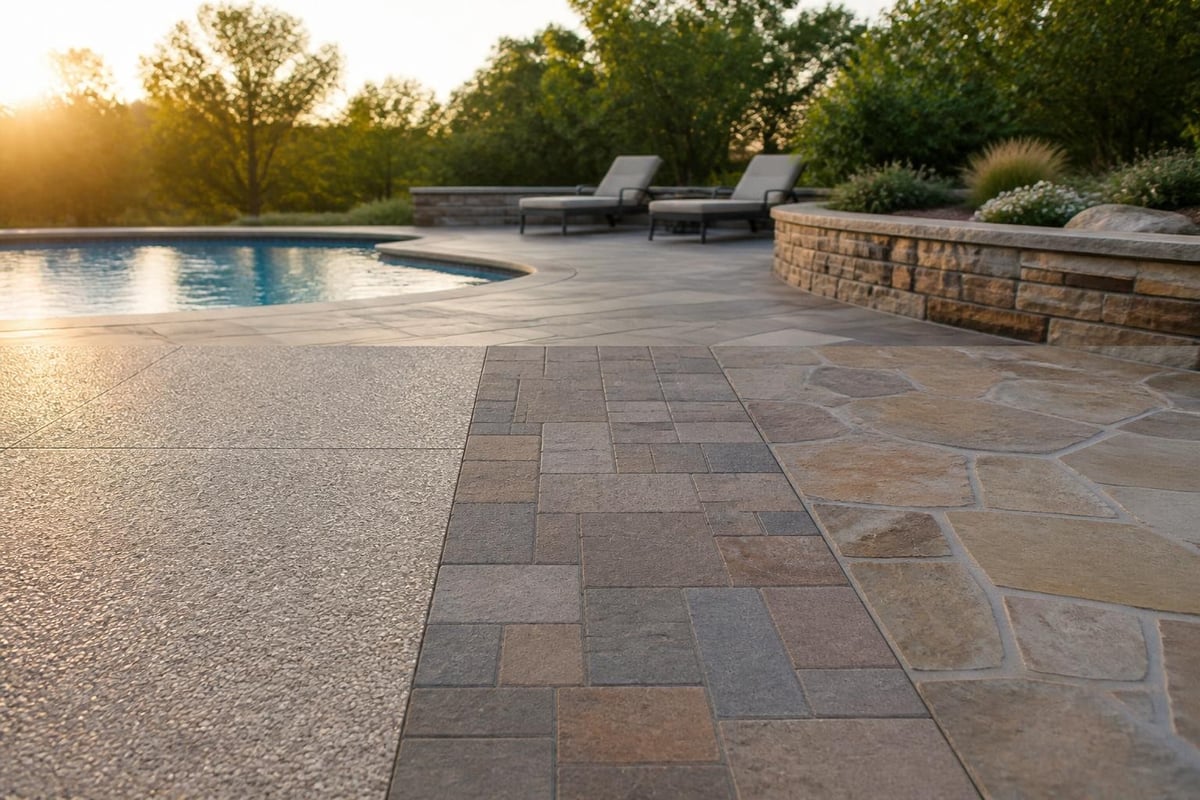
Poured concrete remains the most versatile and economical decking choice. Surface finishes range from basic broom finish ($8-12 per square foot) to elaborate decorative treatments.
- Brushed concrete: Textured surface for slip resistance, affordable, minimal maintenance
- Stamped concrete: Patterns mimic stone or brick, wide color range, $12-18 per square foot
- Cool deck coating: Reduces surface temperature, comfortable for bare feet, requires periodic resealing
- Exposed aggregate: Reveals decorative stones, excellent traction, $15-20 per square foot
All concrete decks require control joints every eight to ten feet to manage cracking from temperature changes and settling. Proper sub-base preparation-typically four to six inches of compacted aggregate-prevents future settling and cracking.
Paver Decking Systems
Interlocking pavers offer superior aesthetics, easy repair (individual units can be replaced), and excellent drainage. The Concrete Masonry & Hardscapes Association publishes detailed installation standards for paver base preparation and edge restraint.
Paver installation layers (bottom to top):
- Compacted native soil or engineered fill
- Geotextile fabric to prevent base migration
- 6-8 inches compacted aggregate base
- 1 inch bedding sand, screeded level
- Pavers with 1/8-inch joint spacing
- Polymeric sand swept and activated in joints
Popular paver materials include concrete (most affordable at $10-15 per square foot installed), natural travertine (cool surface, $18-25 per square foot), and porcelain (extremely durable, $20-30 per square foot). Many Los Angeles homeowners choose pavers when working with Hardscape & Landscape specialists who can coordinate pool deck installation with adjacent patios and walkways for a cohesive design.
Tile and Natural Stone
Premium installations incorporate porcelain tile or natural stone like bluestone, flagstone, or granite. These materials require professional installation over concrete substrate and typically cost $25-50 per square foot.
Natural stone considerations: Some stones (limestone, sandstone) are porous and require sealing to prevent staining from pool chemicals and organic debris. Darker stones absorb heat and can become uncomfortably hot in direct summer sun.
Critical Construction Details
Success in pool and deck installation depends on getting fundamental details right-aspects that aren't visible in the finished product but determine long-term performance.
Drainage and Water Management
California's stormwater management requirements affect how contractors design pool deck drainage. Decks must slope away from buildings at minimum 1/4 inch per foot and direct runoff to permeable surfaces or collection systems.
Deck drainage strategies:
- Slope deck surface toward lawn or planter areas (most economical)
- Install trench drains at deck perimeter to collect overflow and rain
- Route deck drains to sump or area drain connected to storm system
- Never direct pool backwash or deck drainage to sanitary sewer
Pool splash-out and backwash discharge must comply with local water quality regulations. Many jurisdictions require pools to connect to sanitary sewer for filter backwash, while others allow discharge to storm drains if water has been dechlorinated.
Expansion Joints and Movement
Temperature fluctuations cause concrete to expand and contract. Pool and deck installation must accommodate this movement to prevent cracking and structural damage.
Isolation joint locations:
- Between pool coping and deck surface (allows independent movement)
- Where deck meets building foundations or walls
- At intervals across large deck expanses (maximum 20-foot spacing)
- Around fixed objects like equipment pads or planters
Contractors fill expansion joints with closed-cell backer rod and flexible polyurethane or silicone sealant. This detail prevents water infiltration while allowing movement.
Electrical Bonding and Safety
The National Electrical Code mandates bonding all metal within five feet of pool water-including reinforcement steel, coping, handrails, light fixtures, and equipment. A continuous #8 copper bonding conductor connects these components to eliminate voltage gradients that could cause shock.
Required electrical safety features:
- GFCI protection on all pool equipment and lighting circuits
- Underwater lights rated for submersion with sealed housings
- Minimum 10-foot clearance from overhead power lines to water
- Bonding of metal fencing, gates, and pergola posts near pool
Many licensed pool contractors employ dedicated electrical specialists who ensure compliance with these life-safety requirements during the installation process.
Equipment Selection and Placement
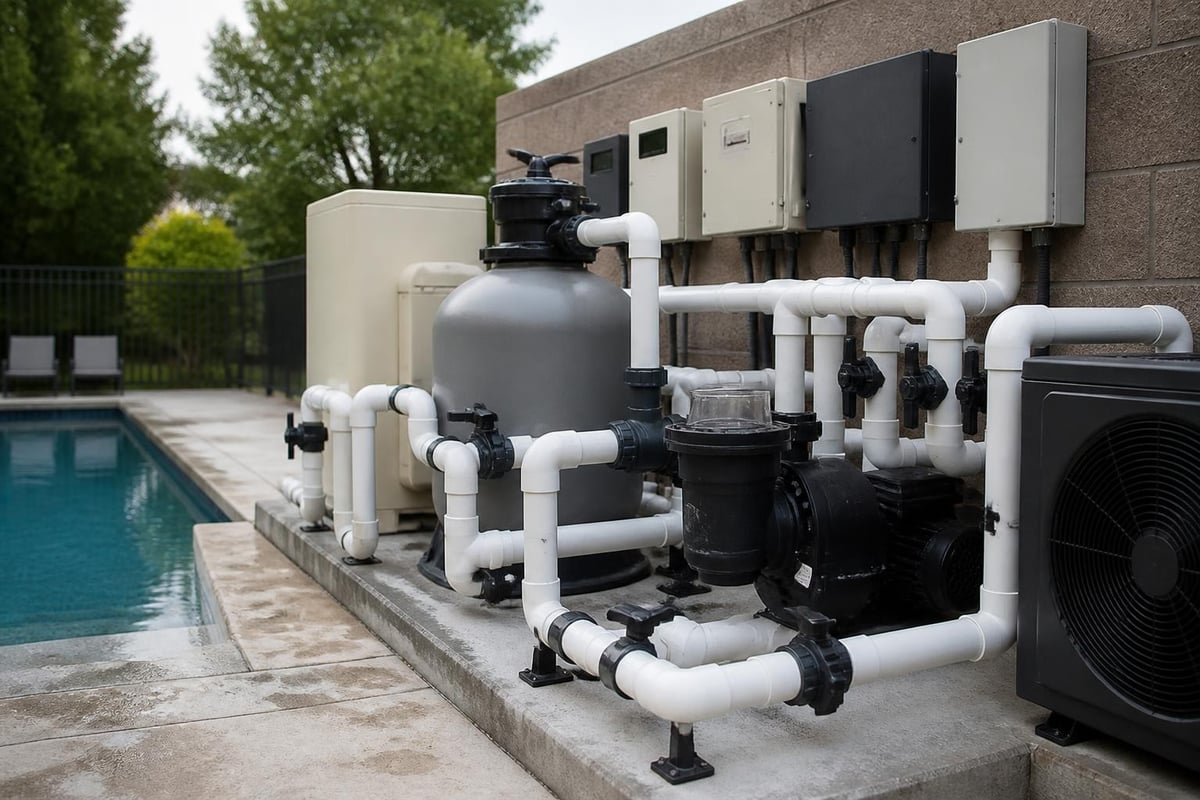
The mechanical systems that filter, heat, and sanitize pool water represent significant portions of both construction cost and long-term operating expense. Strategic equipment choices impact energy bills for decades.
Filtration Systems
Modern pools use one of three filter technologies, each with distinct performance characteristics and maintenance requirements.
| Filter Type | Media | Filtration Level | Backwash Frequency | Initial Cost |
|---|---|---|---|---|
| Sand | Silica sand | 20-40 microns | Every 2-4 weeks | $300-600 |
| Cartridge | Pleated polyester | 10-20 microns | Clean quarterly | $600-1,200 |
| DE (diatomaceous earth) | Fossilized diatoms | 3-5 microns | Monthly | $800-1,500 |
Cartridge filters have gained popularity in California due to water conservation-they're cleaned by hosing rather than backwashing, saving thousands of gallons annually. Proper sizing requires matching filter surface area to pump flow rate per manufacturer specifications.
Heating Options
Los Angeles's mild climate makes pools usable year-round with appropriate heating. Three technologies dominate the market:
Gas heaters ($2,500-4,000 installed): Heat water quickly regardless of air temperature, ideal for spas and occasional use, higher operating cost ($300-600 monthly in winter).
Heat pumps ($4,000-6,500 installed): Extract heat from air, highly efficient in temperatures above 50°F, slower heating, lower operating cost ($100-200 monthly in winter).
Solar systems ($4,000-8,000 installed): Zero operating cost, require roof or ground space for panels, climate-dependent performance, excellent return on investment in sunny regions.
Many homeowners install hybrid systems-heat pump for season extension combined with gas heater for quick spa heating or cold snaps.
Automation and Controls
Smart pool controls manage equipment schedules, adjust chemical feeders, and enable remote monitoring from smartphones. Modern systems integrate:
- Variable-speed pump control (required by California Title 24 for energy compliance)
- Automated chlorine generators that produce sanitizer from salt
- pH and ORP sensors that dose acid and chlorine automatically
- Valve actuators that switch between pool and spa circulation
- LED lighting with color-changing programs
Initial investment in quality automation ($2,000-5,000) typically pays back through reduced chemical use and optimized pump operation within three to five years.
Timeline and Project Phasing
Understanding realistic timelines helps homeowners plan around construction and set appropriate expectations. Pool and deck installation unfolds in distinct phases, each with dependencies on weather, inspections, and material delivery.
Typical Construction Sequence
Weeks 1-2: Layout and excavation. Contractors mark pool outline with spray paint, call for utility locates, then excavate to design depth plus six inches for plumbing substrate. Excavated soil is hauled off or spread on-site per grading permit.
Weeks 3-4: Steel installation and plumbing. Rebar is tied in grid pattern per engineering plans (typically 12-inch spacing), and all plumbing lines are installed and pressure-tested before inspection.
Week 5: Gunite or shotcrete application. Shell is sprayed in single day, then cured with water spray or curing compound for seven days minimum.
Weeks 6-8: Tile work and equipment installation. Waterline tile, coping stones, and any raised wall veneer is set. Pump, filter, heater, and automation equipment is installed and plumbed.
Weeks 9-10: Deck construction. Forms are set, rebar or wire mesh installed, and concrete placed. Paver decks require base excavation, compaction, and unit installation during this window.
Weeks 11-12: Interior finish and startup. Plaster or aggregate finish is applied (pool must be filled within 24 hours). Equipment is commissioned, water balanced, and system tested.
Weather and Seasonal Considerations
Southern California's dry summers offer ideal construction conditions, while winter rains can delay excavation and concrete work. Many contractors recommend starting projects in early spring for summer completion, though skilled crews work year-round.
Winter construction challenges: Wet soil complicates excavation, plaster curing requires warmer temperatures (minimum 50°F), and rain can damage freshly placed concrete decks.
Summer advantages: Predictable weather, faster material curing, extended daylight hours for crews, optimal conditions for landscape installation around completed pool.
Cost Factors and Budget Planning
Pool and deck installation costs vary dramatically based on size, features, and finish quality. Los Angeles market rates reflect higher labor costs and strict permitting requirements compared to less regulated regions.
Base Construction Costs
A basic 400-square-foot gunite pool with standard plaster finish and 600 square feet of brushed concrete deck typically costs $75,000-95,000 including permits and basic equipment. This baseline includes:
- Excavation and steel installation
- Standard circulation equipment (1.5 HP pump, cartridge filter)
- PVC plumbing and basic jets
- Single-color LED lighting
- Salt chlorine generator
- Basic pool-to-equipment automation
Every customization adds cost. Attached spas increase budgets by $12,000-18,000, while features like waterfalls ($8,000-15,000), fire bowls ($3,000-6,000 each), and beach entries ($15,000-25,000) quickly expand project scope.
Premium Upgrades and Features
Homeowners seeking resort-quality installations should budget for enhanced finishes and features:
- Upgraded interior surfaces: Pebble finish adds $6,000-10,000; full tile interior adds $40,000-80,000
- Vanishing edge: Engineering and construction complexity adds $25,000-50,000
- Raised spa with spillway: Integration with pool adds $18,000-30,000
- Travertine paver deck: Premium over standard concrete is $12,000-20,000 for 600 square feet
- Fire and water features: Combined fire bowls and deck jets add $15,000-35,000
- Outdoor kitchen integration: Adjacent bar and grill area adds $25,000-75,000
Detailed cost breakdowns for various pool configurations are available through resources like pool construction pricing guides that reflect current Los Angeles market conditions.
Code Compliance and Safety Requirements
California enforces comprehensive safety regulations for residential pools, with requirements that exceed many other states. Understanding these mandates prevents costly corrections and ensures family safety.
Barrier Requirements
All pools must have isolation barriers preventing unsupervised child access. The Pool & Hot Tub Alliance standards provide detailed technical specifications for compliant barriers.
Acceptable barrier options:
- Property fence at least 5 feet high with self-closing, self-latching gates
- House wall as one barrier side if all doors have alarms
- Pool safety cover meeting ASTM F1346 standards
- Removable mesh fencing as temporary barrier during construction
Gates must swing away from pool, latches must be at least 54 inches above grade (out of young children's reach), and barrier gaps cannot exceed 4 inches to prevent climbing or squeezing through.
Deck Surface Standards
California requires slip-resistant deck surfaces around pools. The Uniform Swimming Pool, Spa and Hot Tub Code specifies minimum friction coefficients for wet surfaces, particularly in commercial applications, though residential contractors follow similar guidelines.
Slip resistance strategies:
- Textured concrete (broom finish, exposed aggregate, or applied coatings)
- Pavers with textured surfaces designed for wet applications
- Avoiding polished or honed finishes on natural stone
- Applying anti-slip sealers to existing smooth surfaces
Beyond code minimums, homeowners should consider practical safety features like contrasting coping colors that define pool edges and adequate lighting for nighttime use.
Selecting the Right Contractor
The complexity of pool and deck installation demands experienced professionals who coordinate multiple trades, navigate permitting, and deliver quality that lasts decades. Contractor selection represents the single most important decision in the entire process.
Licensing and Insurance Verification
California requires pool contractors to hold either a C-53 Swimming Pool license or B General Contractor license. Verify credentials through the Contractors State License Board website before signing contracts. Confirm the contractor carries:
- General liability insurance (minimum $1 million coverage)
- Workers' compensation insurance for all employees
- Contractor's bond (required for licensing)
- Automobile insurance for company vehicles
Request certificates of insurance listing your property address as additionally insured. This protection shields you from liability if workers are injured on your property.
Evaluating Proposals and References
Quality contractors provide detailed written proposals specifying materials, construction methods, timeline, payment schedule, and warranty terms. Compare proposals on these factors:
- Exact material specifications (not just "pool finish" but "Pebble Tec in Tahoe Blue")
- Construction methodology and sequencing
- Included features versus optional upgrades
- Warranty coverage (structure, equipment, finish)
- Payment terms and lien release process
Visit completed projects similar to your planned installation. Speak with recent clients about communication, problem-solving, site cleanliness, and whether the project finished on budget and schedule.
Questions to Ask Prospective Contractors
- How many pool and deck installations have you completed in Los Angeles County?
- Will you pull all permits and schedule inspections?
- Who will supervise daily construction (owner, project manager, foreman)?
- What warranty do you provide on structure, equipment, and finish?
- How do you handle change orders and unexpected conditions?
- Will you provide lien releases from all subcontractors and suppliers?
- What is your typical payment schedule?
Contractors who answer thoroughly and provide documentation build confidence in their professionalism and capability to deliver successful projects.
Pool and deck installation transforms outdoor living spaces but demands careful planning, quality materials, and skilled execution across multiple construction disciplines. Success requires coordinating engineering, permitting, excavation, structural work, equipment installation, and finish details while maintaining code compliance and budget control throughout the months-long process. AM Builds Inc. brings 15+ years of Los Angeles pool and deck installation experience, handling every aspect from initial design through final inspection with licensed expertise (CSLB #1153503), transparent pricing, and direct owner involvement on every project. Contact AM BUILDS CA at (424) 485-4548 for a free consultation and discover how a family-owned contractor delivers custom gunite pools and premium paver decks built to last.


