


Choosing the right professional to build your backyard pool represents one of the most significant home improvement decisions you'll make. The difference between hiring a licensed pool contractor and an unlicensed builder extends far beyond paperwork-it affects project safety, legal protections, quality standards, and long-term satisfaction. Understanding what licensing means, why it matters, and how to verify credentials empowers homeowners to make informed decisions that protect their investment and ensure their project meets all regulatory requirements.
Understanding Pool Contractor Licensing Requirements
Professional licensing for pool construction varies significantly across states and municipalities, but the core purpose remains consistent: protecting consumers and ensuring minimum competency standards. A licensed pool contractor has demonstrated knowledge of construction practices, business operations, and safety regulations through examinations and experience verification.
In California, pool contractors must hold either a C-53 Swimming Pool Contractor license or a broader B General Building Contractor classification. The C-53 specialty classification specifically authorizes construction, installation, and repair of swimming pools, spas, and related equipment. These professionals must pass trade-specific examinations covering hydraulics, filtration systems, electrical requirements, and structural engineering principles.
State-by-State Variations
Licensing frameworks differ considerably across the United States. Florida requires contractors to register through the Department of Business & Professional Regulation, with distinct classifications for residential and commercial pool work. The Florida licensing portal details examination requirements, insurance minimums, and continuing education mandates.
Key licensing components typically include:
- Written examinations on trade knowledge and business law
- Proof of relevant work experience (often 4+ years)
- Financial solvency requirements
- General liability insurance minimums
- Workers' compensation coverage
- Surety bonds protecting consumers
Some jurisdictions impose additional local requirements beyond state credentials. Los Angeles County, for example, requires separate permits and inspections that a licensed pool contractor coordinates throughout the construction process.

Legal Protections That Come With Proper Licensing
Hiring a licensed pool contractor provides critical legal safeguards that unlicensed builders cannot offer. These protections extend to financial recourse, liability coverage, and warranty enforcement-elements that become essential when problems arise.
Financial Security Mechanisms
Licensed contractors must maintain surety bonds that protect homeowners if the contractor fails to complete work, violates contract terms, or doesn't pay subcontractors. Bond amounts vary by state but typically range from $15,000 to $100,000. If a licensed pool contractor abandons a project mid-construction, the homeowner can file a claim against this bond to recover financial losses.
Insurance requirements represent another layer of protection. Licensed professionals carry general liability coverage for property damage and bodily injury, plus workers' compensation for employees. When an unlicensed worker falls from scaffolding on your property, you may face personal liability. With a licensed pool contractor, their workers' comp policy covers medical expenses and lost wages.
| Protection Type | Licensed Contractor | Unlicensed Builder |
|---|---|---|
| Surety Bond | Required ($15K-$100K) | None |
| General Liability | Minimum coverage mandated | Optional/often absent |
| Workers' Comp | Required for employees | Rarely carried |
| License Board Recourse | Complaints investigated | No regulatory oversight |
| Contract Enforceability | Full legal standing | Limited/void in some states |
Regulatory Oversight and Complaint Resolution
State licensing boards investigate consumer complaints against licensed contractors. If a licensed pool contractor performs substandard work, homeowners can file formal complaints that trigger investigations. Boards have authority to impose fines, require corrective work, suspend licenses, or revoke credentials entirely.
Unlicensed builders operate outside this oversight system. Homeowners must pursue remedies solely through civil court, a costly and time-consuming process with uncertain outcomes.
Code Compliance and Safety Standards
Building codes exist to protect public health and safety, and a licensed pool contractor possesses current knowledge of these evolving requirements. Pool construction involves complex intersections of structural engineering, electrical systems, plumbing, and chemical management-each governed by specific code provisions.
The International Swimming Pool and Spa Code provides model standards many jurisdictions adopt or reference. These regulations address barrier requirements, electrical bonding and grounding, suction entrapment prevention, water quality systems, and structural integrity. Licensed contractors study these codes as part of their examination process and stay current through continuing education.
Critical Safety Elements
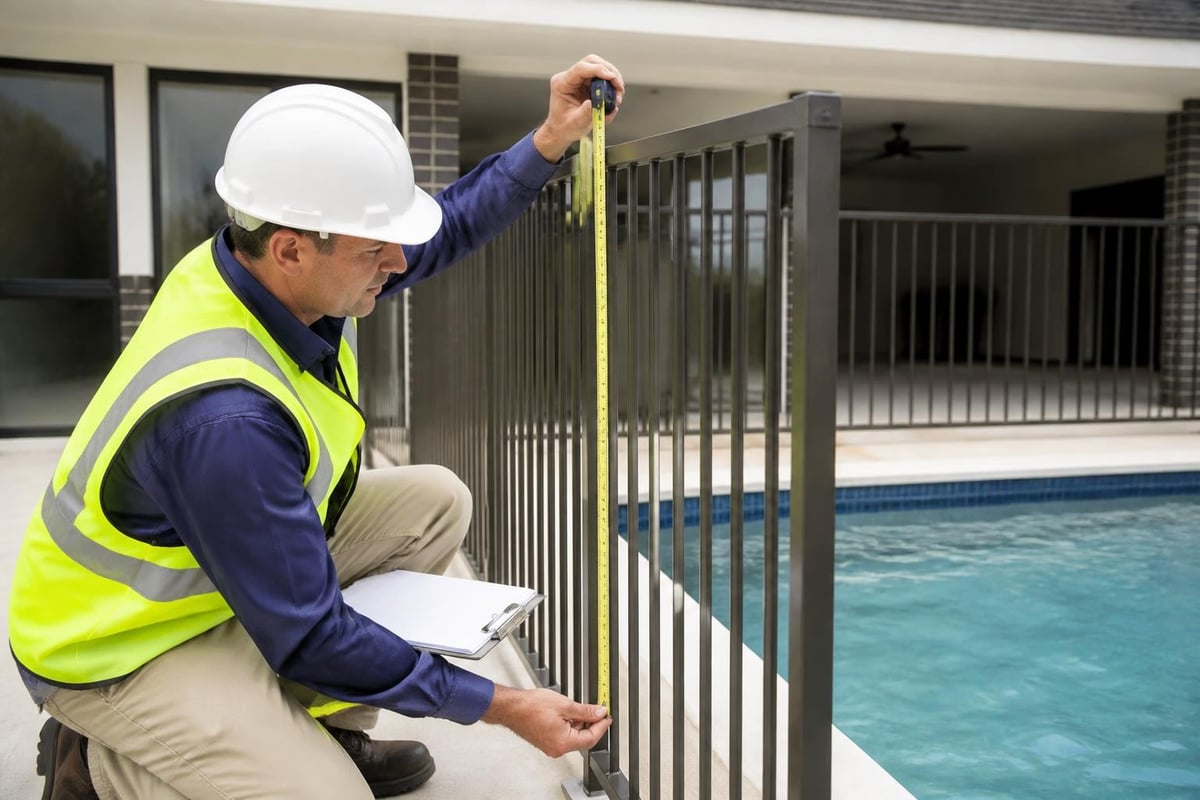
Barrier and fencing requirements prevent unsupervised access, particularly protecting young children. Code specifies minimum heights, maximum gap dimensions, self-closing and self-latching gates, and prohibited climbable elements within perimeter zones. A licensed pool contractor understands these nuanced requirements and designs compliant installations from the start. Our guide to swimming pool fence installation covers the code-compliant layouts, materials, and costs for Los Angeles homes.
Electrical systems require particular expertise. Pools demand GFCI protection, proper bonding of metallic components, specific circuit capacities, and carefully calculated clearances between electrical equipment and water. Errors in these systems create electrocution hazards that can prove fatal.
When you work with a licensed general contractor in Los Angeles specializing in pool construction, you benefit from professionals who coordinate electrical, plumbing, and structural inspections as required by local building departments.
Professional Certifications Beyond Basic Licensing
While state licensing establishes minimum competency, additional certifications demonstrate advanced expertise and ongoing professional development. These credentials signal commitment to industry best practices and specialized knowledge.
Industry Association Credentials
The Pool & Hot Tub Alliance offers certification pathways for pool builders, designers, and service technicians. Their Certified Building Professional (CBP) designation requires documented experience, examination, and continuing education. These programs cover hydraulic design, energy efficiency, automated systems, and advanced construction techniques.
Contractors pursuing these certifications stay current with emerging technologies, environmental regulations, and installation innovations. A licensed pool contractor with PHTA certification brings enhanced technical knowledge to complex projects involving elaborate water features, infinity edges, or integrated automation systems.
Specialized Training Areas
Beyond general construction knowledge, specialized certifications address focused aspects of pool work:
- Hydraulic design certification: Advanced understanding of pump sizing, pipe friction loss, filtration capacity, and energy-efficient equipment selection
- Construction management: Project scheduling, subcontractor coordination, and quality control systems
- Green/sustainable building: Energy-efficient equipment, solar heating, variable-speed pumps, and environmentally responsible construction practices
Questions to Ask When Vetting Pool Contractors
Due diligence before signing a contract protects your investment and increases project success probability. A thorough vetting process goes beyond confirming a license exists-it evaluates experience, business practices, and compatibility.
License Verification Steps
Start by obtaining the contractor's license number and verifying it through your state licensing board website. California homeowners can check credentials through the CSLB database, confirming the license is current, in good standing, and includes the appropriate classification for pool construction.
Essential verification points:
- License status (active, expired, suspended)
- Classification type (C-53, B, or equivalent in your state)
- Bond status and amount
- Workers' compensation exemption or coverage
- Complaint history and disciplinary actions
- License issue date (indicating years in business)
Request copies of insurance certificates and contact the insurance company directly to verify coverage remains current. Policies can lapse even when contractors claim coverage.
Experience and Portfolio Assessment
Years holding a license matters, but evaluate the type and scale of completed projects. Review portfolios focusing on projects similar to yours in scope, design complexity, and budget range. A licensed pool contractor with extensive experience building basic rectangular pools may lack expertise for projects involving vanishing edges, beach entries, or integrated spas.
Ask for references from recent clients-preferably within the past 12 months. Older references may not reflect current business practices, crew composition, or quality standards. When contacting references, inquire about:
- Budget adherence and transparency in change orders
- Timeline accuracy and communication during delays
- Job site cleanliness and professionalism
- Problem-solving when unexpected issues arose
- Post-construction support and warranty service
Contract Terms and Business Practices
Professional contracts from a licensed pool contractor should clearly specify scope of work, materials, payment schedules, timeline, permit responsibilities, and warranty terms. Vague contracts create disputes and leave homeowners vulnerable to cost overruns.
| Contract Element | What to Verify |
|---|---|
| Payment schedule | No more than 10% deposit (CA law); progress payments tied to milestones |
| Permit responsibility | Contractor obtains and pays for all permits |
| Lien releases | Partial and final lien releases from contractor and subs |
| Change order process | Written approval required before additional work |
| Warranty coverage | Minimum 1 year on workmanship; equipment per manufacturer |
| Timeline | Specific start and completion dates with weather allowances |
California law limits initial deposits to $1,000 or 10% of contract price, whichever is less. Any licensed pool contractor demanding larger upfront payments violates state regulations, raising red flags about their financial stability.
The True Cost of Choosing Unlicensed Builders
Budget constraints tempt some homeowners toward unlicensed builders offering substantially lower bids. This short-term savings creates long-term risks that often exceed any initial cost difference.
Financial and Legal Consequences
In many states, contracts with unlicensed contractors are unenforceable in court. If disputes arise, you cannot sue for breach of contract or substandard workmanship. Your only recourse involves proving fraud or negligent misrepresentation-far more difficult legal standards.
Permit violations create serious complications. Work performed without required permits can:
- Prevent you from selling your home until corrected
- Result in municipal fines and stop-work orders
- Require expensive removal and reconstruction to code
- Void homeowner's insurance coverage for pool-related claims
- Create liability if accidents occur due to code violations
Insurance companies may deny claims related to unpermitted work. If a pool deck collapses or electrical malfunction causes injury, your homeowner's policy could exclude coverage entirely, exposing you to catastrophic personal liability.
Quality and Safety Risks
Unlicensed builders lack the training, examination, and oversight that licensing requires. They often cut corners on essential safety features, use substandard materials, or employ improper construction techniques. Common problems include:
- Inadequate steel reinforcement leading to structural cracks
- Improperly sized pumps and filtration systems
- Dangerous electrical installations without proper bonding
- Poor drainage causing deck settlement and water intrusion
- Skipped steps in shotcrete or plaster application
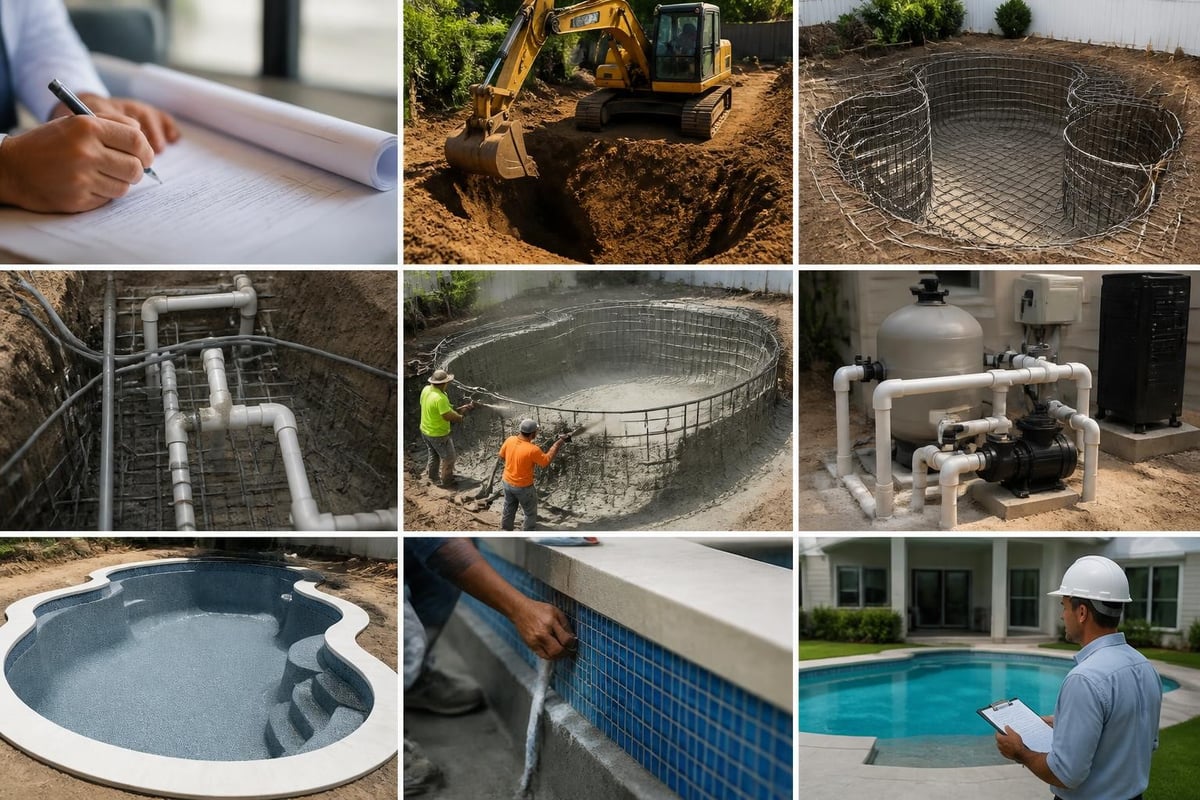
When working with a licensed contractor specializing in custom in-ground pool construction, you ensure that every phase follows engineering specifications and building codes. These projects involve excavation, steel placement, plumbing installation, electrical work, shotcrete application, tile setting, and deck construction-each requiring specific expertise and inspection approval.
Accessibility Requirements and Public vs. Private Projects
Regulations vary significantly between residential and commercial pool construction. A licensed pool contractor must understand which requirements apply to your specific project based on property type, pool usage, and jurisdiction.
ADA Compliance for Commercial Facilities
Commercial pools-including those at hotels, fitness centers, and community associations-must meet Americans with Disabilities Act accessibility standards. These requirements mandate specific means of entry, including pool lifts, sloped entries, transfer walls, or accessible stairs.
The technical specifications are detailed and non-negotiable. Pool lifts must meet weight capacity minimums, seat heights, footrests, and operational force limits. Sloped entries require specific gradients, handrail configurations, and landing dimensions. Licensed contractors working on commercial projects must design and install these features in full compliance with federal law.
Residential Considerations
While private residential pools face fewer accessibility mandates, homeowners may choose accessible features for aging-in-place considerations or family members with mobility limitations. A knowledgeable licensed pool contractor can incorporate these elements into residential designs, balancing functionality with aesthetics and budget.
Insurance Considerations for Pool Construction Projects
Pool construction insurance extends beyond the contractor's general liability and workers' compensation policies. Understanding the full risk management picture protects both parties throughout the project.
Builder's Risk Coverage
Large pool projects often involve builder's risk insurance covering the structure during construction. This specialized policy protects against fire, theft, vandalism, and weather damage before project completion. Construction insurance considerations become particularly important for high-value projects with extended timelines.
A licensed pool contractor typically includes builder's risk coverage for materials and work-in-progress. This protects your investment if a storm damages partially completed gunite work or thieves steal expensive pool equipment stored on-site.
Homeowner Policy Implications
Notify your homeowner's insurance carrier when starting pool construction. The addition substantially increases property value and liability exposure. Carriers may require policy endorsements, increase premiums, or mandate specific safety features like perimeter fencing before providing coverage.
Discuss these requirements with your licensed pool contractor during design phases. Incorporating carrier-required safety features into initial plans costs less than retrofitting them after construction.
Permit Management and Inspection Processes
Navigating municipal permit requirements represents a significant advantage of hiring a licensed pool contractor. The permitting process involves multiple departments, detailed plan submissions, and sequential inspections throughout construction.
Plan Submission and Review
Building departments require engineered plans showing pool dimensions, equipment locations, electrical and plumbing schematics, drainage plans, and barrier details. Plans must demonstrate code compliance for structural design, setbacks, easements, and utility clearances.
Licensed contractors maintain relationships with plan reviewers and understand local preferences for plan format, required details, and common revision requests. This expertise accelerates approval timelines compared to homeowners or unlicensed builders navigating the process for the first time.
Typical inspection sequence:
- Footing and steel inspection before shotcrete
- Plumbing rough-in before backfill
- Electrical rough-in and bonding
- Decking and drainage systems
- Barrier and fencing compliance
- Final inspection and operating permit
Missing or failed inspections create project delays and may require expensive corrective work. A licensed pool contractor schedules inspections appropriately and ensures work meets standards before calling inspectors.
Code Compliance Across Jurisdictions
Model codes like the Uniform Swimming Pool, Spa and Hot Tub Code provide baseline standards, but local jurisdictions often impose additional requirements. Los Angeles may have specific requirements for seismic reinforcement, water conservation measures, or energy-efficient equipment that differ from neighboring cities.
Experienced licensed pool contractors know these local variations and design accordingly. When you're planning pool remodeling projects or new construction, working with contractors familiar with your specific jurisdiction prevents costly redesigns mid-project.
Evaluating Contractor Communication and Project Management
Technical expertise matters, but communication quality and project management practices significantly impact your construction experience. A skilled licensed pool contractor delivers not just a quality pool, but also a manageable, transparent process.
Communication Expectations
Establish communication protocols during initial consultations. How does the contractor handle questions? What's the typical response timeframe? Who serves as your primary point of contact? Large companies may assign project managers, while smaller operations often provide direct owner involvement.
Clear communication prevents misunderstandings about design details, material selections, and change orders. Confirm the contractor documents all discussions, decisions, and modifications in writing. Verbal agreements create disputes when memories differ about what was promised.
Job Site Management
Professional site management reflects the contractor's overall business practices. Organized job sites with proper material storage, daily cleanup, and clear safety protocols indicate attention to detail extending to construction quality.
Signs of professional site management include:
- Designated material storage areas protecting products from weather
- Daily debris removal and end-of-day cleanup
- Clearly marked utility locations and excavation zones
- Proper safety barriers around excavations and equipment
- Organized tool and equipment storage
- Minimal impact on landscaping and adjacent property areas
Poor site management-scattered materials, abandoned debris, damaged landscaping-often correlates with sloppy construction practices and cost-cutting that compromises quality.
Warranty Terms and Post-Construction Support
Understanding warranty coverage before signing contracts prevents disappointment when issues arise. A licensed pool contractor should clearly specify what's covered, for how long, and under what conditions.
Workmanship vs. Product Warranties
Contractor warranties typically cover workmanship defects-problems resulting from improper installation, construction errors, or failure to follow manufacturer specifications. Product warranties come from equipment and material manufacturers, covering pumps, filters, heaters, and finish products.
Minimum workmanship warranty periods often span one year, though reputable contractors may offer extended coverage on structural elements. Equipment carries manufacturer warranties ranging from one to ten years depending on the component.
Review warranty exclusions carefully. Most exclude damage from improper maintenance, chemical mismanagement, or modifications by other parties. Understand your maintenance responsibilities to preserve warranty coverage.
Service and Support Structure
Post-construction support separates exceptional contractors from adequate ones. Does the contractor offer maintenance services or equipment repair? Can they recommend qualified service providers? How quickly do they respond to warranty claims?
A licensed pool contractor with established business longevity provides greater assurance they'll honor warranties years into the future. Newer businesses or contractors working outside proper licensing frameworks may disappear, leaving homeowners without recourse for defects.
Evaluating Subcontractor Management Practices
Pool construction requires specialized subcontractors for electrical work, plumbing, steel installation, tile setting, and equipment installation. How a licensed pool contractor selects, manages, and coordinates these trades directly impacts project quality and timeline.
Subcontractor Licensing Verification
General contractors often hire electrical and plumbing subcontractors who must carry their own trade-specific licenses. Verify that your licensed pool contractor uses appropriately credentialed subcontractors and obtains lien releases preventing subs from filing claims against your property if the general contractor fails to pay them.
Quality Control Systems
Professional contractors implement quality control processes ensuring subcontractor work meets standards before proceeding to the next construction phase. This might include photographic documentation, checklists for critical steps, or independent inspections beyond municipal requirements.
Ask how the contractor handles subcontractor performance issues. Clear contracts with subs, regular site supervision, and willingness to replace underperforming trades demonstrate professional project management.
Selecting a licensed pool contractor protects your investment through verified expertise, legal safeguards, and regulatory oversight that unlicensed builders cannot provide. The credentials, insurance, bonding, and code knowledge that licensing requires create accountability and quality standards essential for successful pool construction. When you're ready to transform your backyard with a custom pool built to the highest standards, AM BUILDS CA brings 15+ years of licensed expertise (CSLB #1153503) to every project. Our family-owned team handles complete design, permitting, construction, and finishing for in-ground pools and surrounding hardscapes throughout Los Angeles. Call (424) 485-4548 for a free, no-obligation estimate and experience the difference professional pool construction makes.


