


Fibreglass swimming pools have transformed the backyard pool industry by offering homeowners a faster, more streamlined alternative to traditional concrete construction. Unlike gunite or shotcrete pools built on-site, fibreglass shells arrive as complete, factory-molded units ready for installation. This approach delivers significant advantages in speed, surface durability, and long-term maintenance, but the installation process requires precise planning, proper site preparation, and strict adherence to local building codes. Understanding what fibreglass swimming pool installation entails helps homeowners make informed decisions about whether this pool type fits their property, budget, and lifestyle.
What Makes Fibreglass Pool Installation Different
Fibreglass swimming pool installation stands apart from conventional pool construction because the shell is manufactured off-site in a controlled factory environment. The pool arrives at your property as a single-piece composite structure made from layers of fibreglass-reinforced plastic (FRP) and resin.
This prefabricated approach eliminates weeks of on-site concrete work, steel installation, and plaster finishing. Instead, the installation focuses on excavation, delivery logistics, precision placement, and proper backfilling.
Factory Manufacturing Process
The manufacturing process creates a structurally integrated shell through multiple layers of resin and fibreglass mat. Manufacturers typically apply a gel coat finish in the mold, ensuring a smooth, non-porous surface that resists algae growth and staining.
Quality control happens in a climate-controlled facility where curing conditions remain consistent. This contrasts sharply with on-site concrete work, where weather, temperature, and humidity can affect the final product.
Many fibreglass pool manufacturers meet ICC-ES acceptance criteria for fiber-reinforced plastic pools, providing third-party validation of structural performance and material quality.
Site Assessment and Preparation Requirements
Before any excavation begins, thorough site assessment determines whether your property can accommodate a fibreglass pool shell. Access width, soil conditions, and underground utilities all play critical roles in project feasibility.
Key site considerations include:
- Minimum 10-foot access width for crane and delivery truck
- Stable soil conditions without excessive groundwater
- Clearance from property lines, septic systems, and structures
- Underground utility locations (gas, electric, water, sewer)
- Easements or setback restrictions
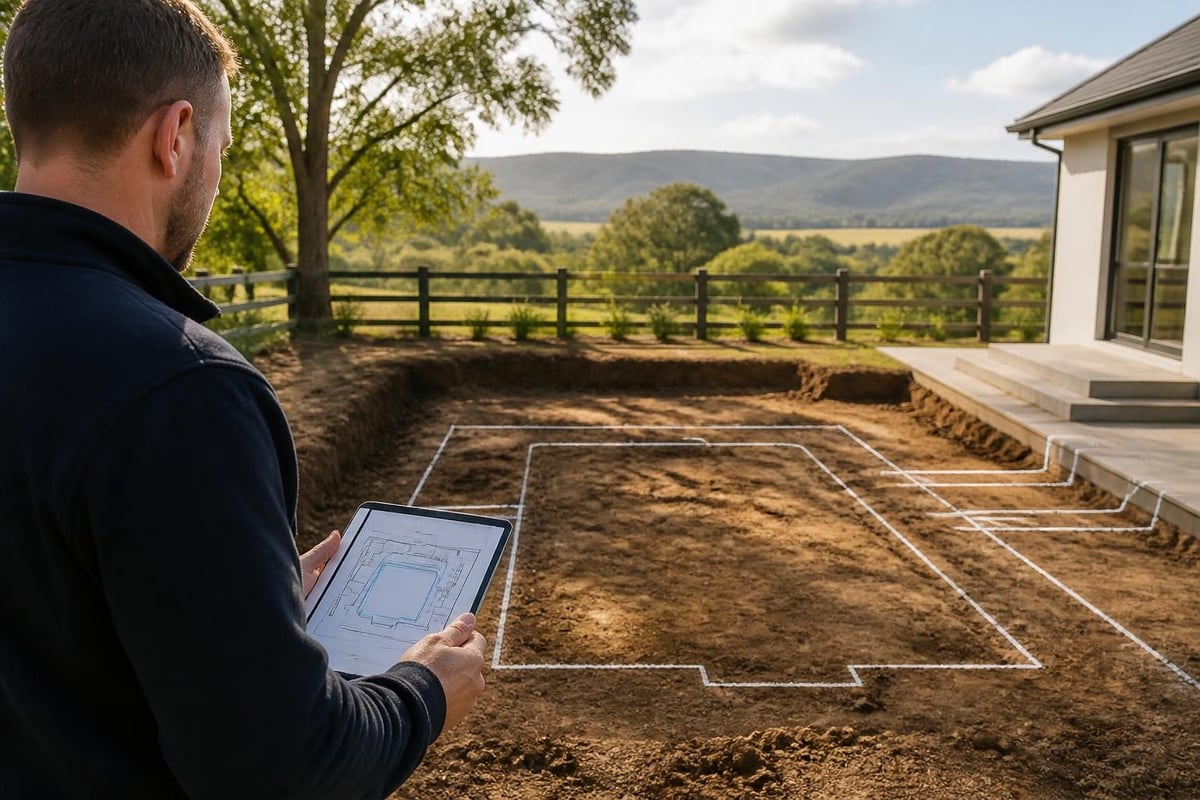
Soil testing often reveals whether additional engineering or stabilization measures are necessary. Expansive clay soils, high water tables, or poor-bearing soils may require special backfill materials or drainage systems.
Permit and Code Compliance
Los Angeles and surrounding municipalities enforce specific requirements for pool installations, including setbacks, fencing, drainage, and structural engineering. The City of Los Angeles building bulletin on swimming pool backfill provides detailed guidance on compaction requirements, material specifications, and inspection protocols.
Working with a licensed contractor ensures permit applications include proper engineering plans, drainage calculations, and equipment specifications. For homeowners considering in-ground pool construction in Los Angeles, understanding local permitting requirements prevents costly delays and rework.
The Fibreglass Pool Installation Timeline
A typical fibreglass swimming pool installation takes 2-4 weeks from excavation to final fill, significantly faster than the 8-12 weeks required for gunite construction. However, permit processing, equipment delivery, and weather can extend this timeline.
| Phase | Duration | Key Activities |
|---|---|---|
| Permit approval | 2-6 weeks | Plans submission, engineering review, approval |
| Excavation | 1-2 days | Dig hole, level base, set grade |
| Delivery & set | 1 day | Crane delivery, shell placement, leveling |
| Plumbing/electrical | 2-3 days | Connect lines, install equipment, backfill |
| Decking & finish | 1-2 weeks | Pour deck, install coping, landscaping |
Excavation Specifications
The excavation must exceed the pool shell dimensions by 12-24 inches on all sides to allow proper backfilling and compaction. Depth measurements account for the base material (typically 6-8 inches of crushed stone or sand) plus the shell depth.
Precision matters during excavation. Over-digging requires additional fill material and creates settling risks. Under-digging necessitates expensive hand work or equipment repositioning.
Most contractors verify excavation dimensions before shell delivery to avoid costly delays. GPS-guided excavation equipment has improved accuracy significantly in recent years.
Delivery and Shell Placement
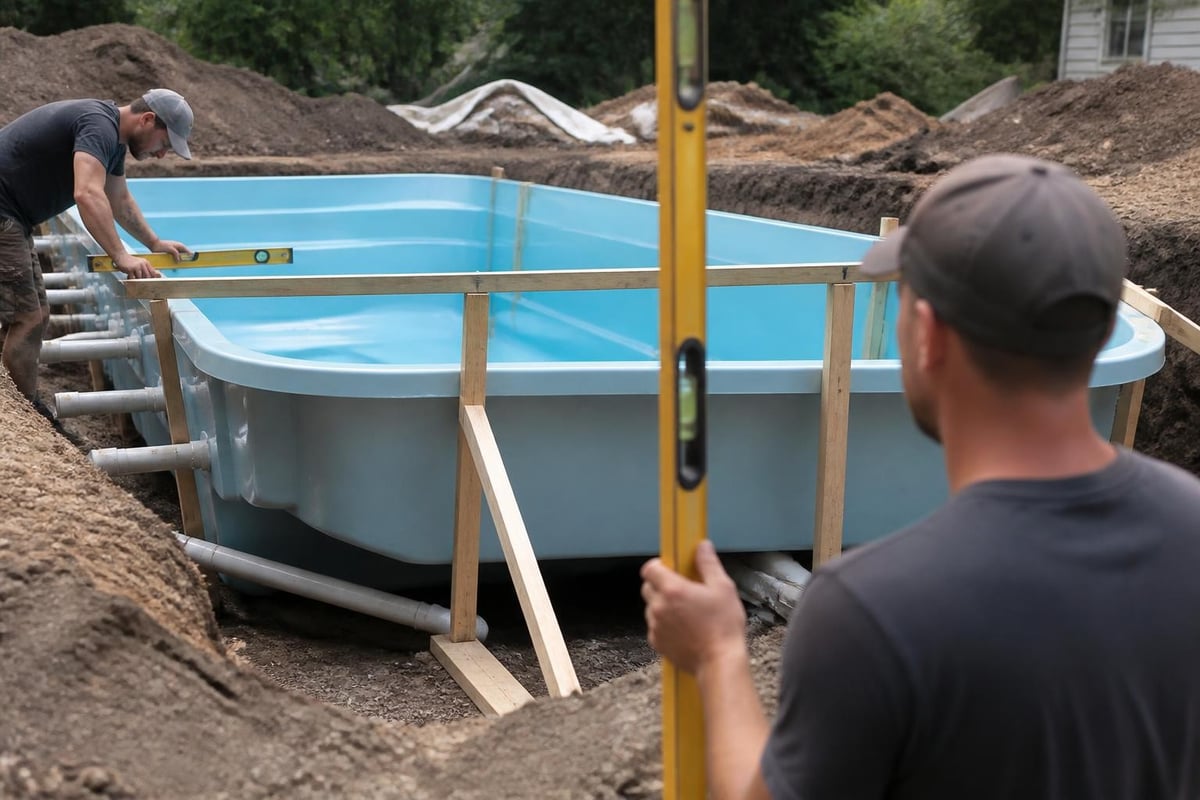
The most visually dramatic moment in fibreglass swimming pool installation occurs when a crane lifts the pool shell and lowers it into the excavation. This operation requires experienced rigging, clear communication, and precise positioning.
Critical placement factors:
- Level base within 1/4 inch across the entire footprint
- Proper orientation for plumbing stub-outs
- Clearance for backfill material placement
- Structural support during backfilling process
The crane operator and installation crew work together to position the shell, checking level in multiple directions before releasing the rigging. Even slight variations can cause long-term structural stress or water drainage issues.
Temporary bracing often supports the shell during backfilling to prevent movement or deformation. The thin fibreglass walls gain strength from proper backfill compaction, not inherent rigidity.
Backfill Materials and Compaction Standards
Proper backfilling represents the most critical aspect of fibreglass swimming pool installation. The backfill material provides structural support for the shell, prevents movement, and ensures long-term stability.
Most installations use either flowable fill (controlled low-strength material) or carefully compacted gravel. Each approach offers distinct advantages depending on soil conditions, access, and local code requirements.
Flowable Fill Method
Flowable fill consists of a self-leveling cement-sand-water mixture that flows around the shell and hardens to a stable but not excessively strong mass. This material eliminates compaction concerns and provides uniform support.
The installation crew fills the pool with water as flowable fill rises around the exterior. This counterbalances the external pressure and prevents shell deformation. The fill and water levels rise together in controlled increments.
Flowable fill cures relatively quickly, allowing faster progression to plumbing and decking work. However, it costs more than traditional gravel backfill and may not be available in all markets.
Gravel Compaction Approach
Compacted gravel backfill requires meticulous layer-by-layer placement and mechanical compaction. Contractors typically use pea gravel or crushed stone in 6-12 inch lifts, compacting each layer before adding the next.
Water filling must occur simultaneously with backfilling to maintain pressure balance. Many contractors fill the pool 12 inches, then backfill 12 inches, repeating until complete.
This method demands more labor and time but offers cost savings and easier future access if excavation becomes necessary for repairs or modifications.
Plumbing and Equipment Integration
Fibreglass pools arrive with pre-molded plumbing stub-outs positioned during manufacturing. The installation crew connects these stub-outs to the equipment pad, where pumps, filters, heaters, and sanitization systems reside.
Standard plumbing connections include:
- Main drain lines (typically two for safety)
- Skimmer suction lines
- Return jet lines
- Spa or water feature circuits
- Automated cleaner ports
- Fill and drain lines
All plumbing must conform to local plumbing codes and pool equipment standards. Licensed contractors ensure proper pipe sizing, support, and pressure testing before burial.
The equipment pad location affects operational efficiency, noise levels, and maintenance access. Most homeowners prefer equipment positioned away from entertainment areas but within reasonable distance to minimize plumbing runs.
Electrical and Control Systems
Modern pool installations require significant electrical infrastructure for pumps, heaters, lighting, automation, and safety systems. A dedicated circuit from the main panel supplies power through ground-fault circuit interrupter (GFCI) protection.
LED lighting systems, automated chemical feeders, and smartphone-controlled equipment have become standard features in 2026 installations. These systems integrate during the installation phase with control panels positioned near the equipment pad.
Bonding all metallic components (rails, ladders, light fixtures, equipment) creates an equipotential plane that prevents dangerous voltage gradients. This electrical safety requirement demands careful attention during installation.
Coping and Deck Integration
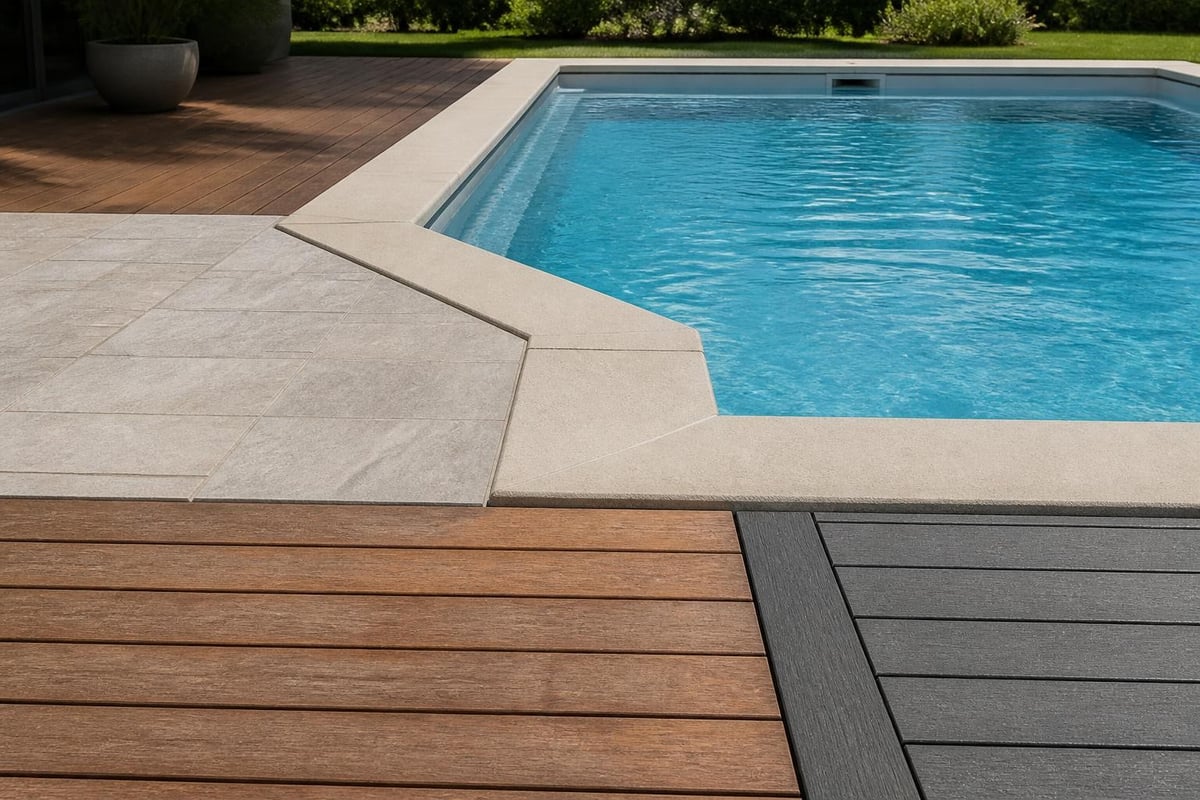
The transition between the fibreglass pool shell and surrounding deck requires careful detailing to ensure watertight performance and attractive appearance. Most fibreglass pools feature a built-in flange or coping ledge designed to interface with various decking materials.
| Decking Material | Installation Method | Typical Cost Range | Maintenance Level |
|---|---|---|---|
| Poured concrete | Direct bond to flange | $8-15/sq ft | Low |
| Pavers | Sand-set or mortar-set | $15-30/sq ft | Medium |
| Travertine | Thin-set on concrete | $20-40/sq ft | Medium |
| Flagstone | Mortar-set irregular | $25-50/sq ft | Medium-High |
The coping detail must accommodate thermal expansion, prevent water infiltration behind the shell, and provide slip-resistant footing around the pool perimeter. Expansion joints allow movement without cracking.
For homeowners interested in premium outdoor living spaces, hardscape and landscape design services extend beyond basic deck installation to include outdoor kitchens, fire features, and integrated seating areas.
Quality Control and Final Inspection
Professional fibreglass swimming pool installation includes multiple inspection points to verify compliance with plans, codes, and manufacturer specifications. These checkpoints catch problems before they become expensive failures.
Critical inspection stages:
- Pre-excavation utility clearance and layout verification
- Excavation dimensions and base preparation
- Shell placement and leveling accuracy
- Backfill material and compaction testing
- Plumbing pressure testing and leak detection
- Electrical bonding and GFCI functionality
- Final municipal inspection and approval
The municipal building inspector examines structural elements, safety barriers, drainage provisions, and code compliance before issuing final approval. This inspection typically occurs after backfilling but before final decking.
Many contractors conduct their own quality inspections at each phase, photographically documenting critical steps. This documentation protects both the homeowner and contractor if questions arise later.
Long-Term Performance Considerations
Fibreglass swimming pool installation quality directly affects decades of pool performance. Proper installation prevents common issues like shell movement, cracking, plumbing leaks, and deck settlement.
The non-porous gel coat surface resists algae growth and chemical staining better than plaster finishes. This translates to lower chemical usage, reduced cleaning time, and decreased long-term maintenance costs.
However, the gel coat can fade or develop surface wear over 15-20 years, particularly in areas with intense sun exposure. Some manufacturers offer warranties covering structural integrity for 25-30 years but limit surface finish coverage to 10-15 years.
Understanding the fiber-reinforced plastic materials used in pool manufacturing helps homeowners appreciate both the advantages and limitations of fibreglass technology.
Cost Factors and Budget Planning
Fibreglass swimming pool installation costs vary significantly based on pool size, site conditions, access challenges, and finish selections. A basic 14×28-foot installation might range from $50,000 to $75,000, while larger or more complex projects can exceed $100,000.
Major cost components include:
- Pool shell and delivery: 30-40% of total
- Excavation and site preparation: 10-15%
- Installation labor and equipment: 15-20%
- Plumbing and electrical systems: 10-15%
- Decking and coping: 15-20%
- Permits and engineering: 3-5%
Site challenges like poor access, soil stabilization needs, or excessive tree removal can add $10,000-$30,000 to baseline estimates. Homeowners should budget contingency funds for unforeseen conditions discovered during excavation.
Comparing fibreglass to gunite construction reveals different value propositions. Fibreglass offers faster installation and lower lifetime maintenance but limited shape options. Gunite provides unlimited customization but requires longer construction periods and higher maintenance.
Selecting a Qualified Installation Contractor
Fibreglass swimming pool installation demands specialized knowledge beyond general excavation or concrete work. The contractor must understand shell handling, backfill requirements, pressure balancing, and manufacturer specifications.
Contractor qualification checklist:
- Valid state contractor license with pool specialty
- Experience with fibreglass pool installations specifically
- Manufacturer certification or training credentials
- Comprehensive liability and workers' compensation insurance
- Recent project references with contact information
- Detailed contract specifying materials and methods
Working with family-owned contractors who maintain direct owner involvement often results in better communication, accountability, and quality control. The owner's reputation depends on every project, creating strong incentive for excellence.
For Los Angeles area homeowners, verifying CSLB license status and reviewing any complaints or disciplinary actions provides important contractor background information. AM BUILDS CA maintains transparency through licensing, insurance, and direct owner communication throughout every project.
Common Installation Challenges and Solutions
Even well-planned fibreglass swimming pool installation encounters occasional obstacles. Experienced contractors anticipate these issues and implement solutions without compromising quality or timeline.
High groundwater presents one of the most significant challenges. If water enters the excavation during installation, the fibreglass shell can float or shift during backfilling. Contractors address this through dewatering pumps, drainage systems, or specialized anchoring techniques.
Access limitations force creative solutions when standard crane positioning proves impossible. Smaller cranes, boom trucks, or even helicopter delivery (extremely rare and expensive) may be necessary for landlocked properties.
Rock excavation costs can exceed initial estimates if bedrock appears shallower than anticipated. The contractor must switch from standard excavation equipment to rock hammers or controlled blasting, adding time and expense.
Warranty Coverage and Manufacturer Support
Reputable fibreglass pool manufacturers provide structural warranties covering shell integrity, typically for 25-30 years or lifetime. Surface finish warranties usually extend 10-15 years against blistering, delamination, or excessive fading.
Understanding warranty terms, coverage limitations, and claim procedures prevents surprises when issues arise. Most warranties require professional installation by certified contractors and exclude damage from improper winterization, chemical misuse, or structural alterations.
The ICC-ES product directory lists manufacturers whose products have undergone independent evaluation, providing additional confidence in product quality and compliance.
Manufacturer support extends beyond warranty coverage to include installation guidelines, equipment recommendations, and troubleshooting assistance. Contractors who maintain relationships with manufacturers can access technical support when unusual situations arise.
Regional Considerations for Los Angeles Installations
Los Angeles presents unique conditions affecting fibreglass swimming pool installation, from seismic requirements to drought-conscious water management. Understanding these regional factors ensures compliant, durable installations.
California building codes require pools to withstand seismic activity through proper anchoring and flexible plumbing connections. The fibreglass shell's monolithic construction offers advantages during earthquakes compared to concrete pools that may crack along construction joints.
Water conservation concerns have led many homeowners to install covers, automated chemical systems, and variable-speed pumps that reduce water waste and evaporation. These features integrate most effectively when planned during initial installation.
Year-round swimming conditions in Southern California justify investments in heating systems, though energy-efficient heat pumps have largely replaced gas heaters for environmental and cost reasons.
Homeowners exploring pool remodeling options can learn how newer technologies and materials improve efficiency and performance compared to older installations.
Fibreglass swimming pool installation offers homeowners a faster path to backyard enjoyment with reduced long-term maintenance compared to traditional concrete construction. Success depends on proper site preparation, precision installation, and strict adherence to manufacturer specifications and local building codes. For Los Angeles area families ready to transform their outdoor living space with professional pool construction, AM BUILDS CA brings 15+ years of licensed expertise, direct owner involvement, and commitment to quality that ensures your investment delivers decades of enjoyment. Contact us at (424) 485-4548 for a free, no-obligation estimate on your pool project.


