


Planning a backyard oasis requires understanding the complete financial picture before you break ground. The cost for building swimming pool in Los Angeles varies dramatically based on size, materials, features, and site conditions, with most homeowners investing between $60,000 and $150,000 for a custom in-ground gunite pool. This comprehensive guide breaks down every expense category, explores factors that influence your final price, and provides practical strategies to budget accurately while avoiding costly surprises. Whether you're considering a simple lap pool or a resort-style retreat with integrated spa and water features, knowing where your dollars go ensures you make informed decisions that align with your vision and financial reality.
Breaking Down the Base Cost for Building Swimming Pool
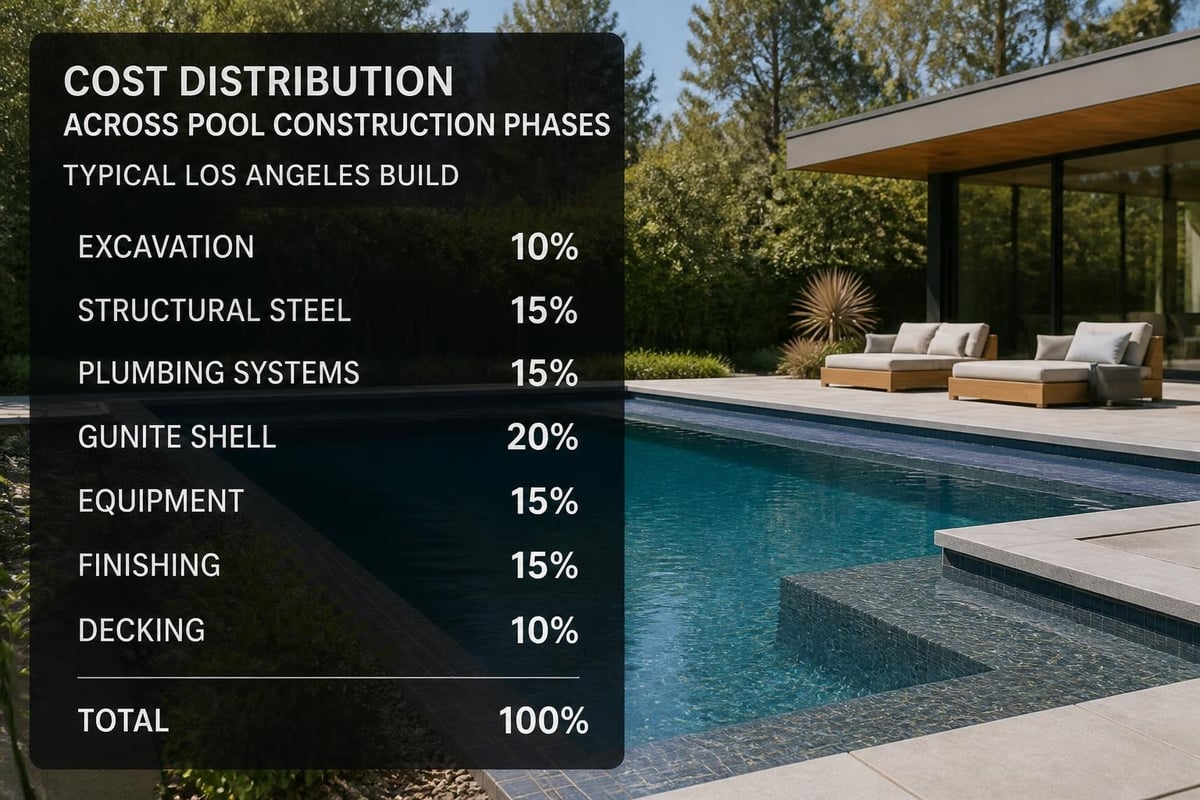
The foundation of any pool budget begins with the shell itself. Gunite pools, the most popular choice in Southern California, typically range from $50 to $100 per square foot for basic construction. A standard 12×24 foot pool (288 square feet) translates to $14,400 to $28,800 for the shell alone, though this represents just one component of your total investment. For a detailed breakdown of shell pricing across materials, see our guide to gunite pool cost per square foot.
Base construction includes several critical phases:
- Excavation and hauling (typically $3,000-$8,000 depending on access and soil conditions)
- Steel reinforcement and structural engineering ($4,000-$7,000)
- Plumbing installation with proper drainage ($3,500-$6,500)
- Gunite or shotcrete application ($8,000-$15,000)
- Initial equipment installation ($5,000-$12,000)
Regional market conditions significantly impact these numbers. State-by-state cost analysis shows Los Angeles consistently ranks among the higher-cost metros due to labor rates, permitting complexity, and strict building codes. Homeowners should expect to pay 15-25% above national averages when planning their budgets.
Material Selection Impact on Total Investment
Your choice of finish materials dramatically influences the final cost for building swimming pool. Plaster remains the most economical option at $3-$5 per square foot, providing 7-10 years of service before resurfacing. Pebble finishes increase durability and aesthetics for $8-$12 per square foot, while premium glass tile can exceed $25 per square foot in high-traffic areas.
Coping and decking represent another significant expense category. Concrete coping starts around $15-$20 per linear foot, while natural stone options like travertine or flagstone range from $30-$60 per linear foot. The deck material you select affects both immediate construction costs and long-term maintenance requirements.
| Material Type | Cost Range (per sq ft) | Lifespan | Maintenance Level |
|---|---|---|---|
| Standard plaster | $3-$5 | 7-10 years | Moderate |
| Pebble finish | $8-$12 | 12-15 years | Low |
| Quartz aggregate | $10-$15 | 10-12 years | Low |
| Glass tile | $25-$40 | 20+ years | Very low |
Permit and Compliance Costs in Los Angeles
Los Angeles County requires comprehensive permitting for all pool construction, adding $1,500 to $4,500 to your project before any physical work begins. This process includes plan review, structural calculations, electrical permits, and multiple inspections throughout construction.
Building departments mandate specific safety features that directly impact your budget. Perimeter fencing must meet height and gap requirements, pool alarms or door sensors protect interior access points, and anti-entrapment drain covers comply with federal Virginia Graeme Baker Pool and Spa Safety Act standards. These safety requirements exist to prevent drownings and injuries but add $3,000-$8,000 to construction costs.
Required compliance elements typically include:
- Four-sided isolation fencing with self-closing, self-latching gates
- Pool alarm systems or door/window sensors for home access points
- Anti-entrapment drain covers and proper hydraulic design
- GFCI protection for all electrical components
- Clearly marked depth measurements and safety signage
Working with a licensed contractor who understands Los Angeles pool regulations streamlines this process and prevents costly correction notices or failed inspections that delay project completion.
Equipment Selection and Energy Efficiency Considerations
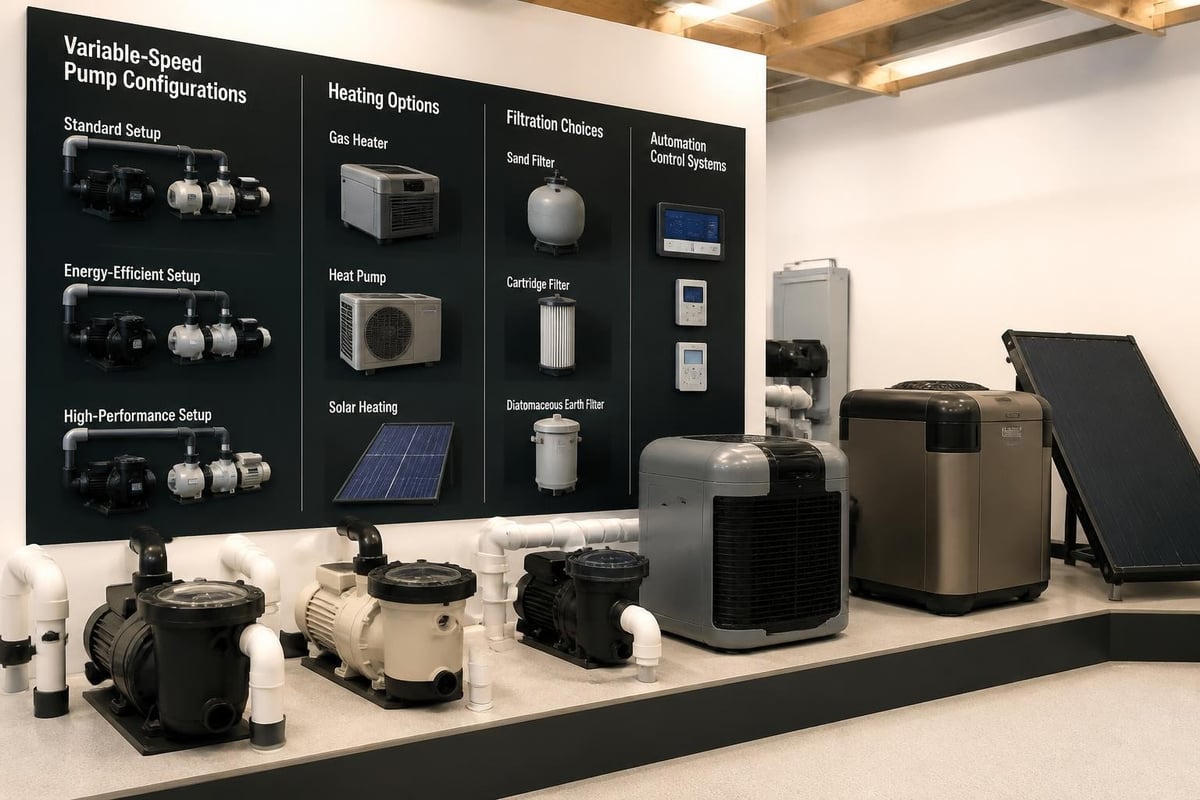
Mechanical equipment represents 10-15% of the total cost for building swimming pool, with choices that significantly affect both upfront investment and ongoing operating expenses. The core system includes pump, filter, heater, and automation controls.
Modern pump technology offers substantial energy savings. Variable-speed pumps cost $1,200-$2,000 compared to $400-$800 for single-speed models, but California's Title 24 energy code now mandates variable-speed equipment for most residential installations. These pumps reduce electricity consumption by 60-80%, recovering their premium through lower utility bills within 18-24 months.
Heating options span a wide cost spectrum. Natural gas heaters provide rapid temperature increase for $2,000-$4,000 installed but carry higher operating costs. Electric heat pumps require $3,500-$6,000 upfront yet deliver superior efficiency, particularly in Southern California's mild climate. Solar heating systems cost $4,000-$8,000 but eliminate ongoing fuel expenses entirely. The Department of Energy guidance on pool heaters provides detailed efficiency comparisons to inform your selection.
| Equipment Type | Installation Cost | Operating Cost (per season) | Best For |
|---|---|---|---|
| Single-speed pump | $400-$800 | $800-$1,200 | Not code-compliant in CA |
| Variable-speed pump | $1,200-$2,000 | $200-$400 | Required by code |
| Gas heater | $2,000-$4,000 | $600-$1,500 | Quick heating needs |
| Heat pump | $3,500-$6,000 | $200-$500 | Year-round comfort |
| Solar heating | $4,000-$8,000 | $0-$50 | Maximum efficiency |
Custom Features and Design Elements
Enhancing your pool with architectural features and luxury amenities can increase the cost for building swimming pool by 30-100% above basic construction. These investments transform a simple rectangle into a personalized backyard resort.
Popular feature additions include:
- Attached spa or hot tub ($8,000-$20,000)
- Tanning ledge or baja shelf ($3,000-$8,000)
- Waterfalls and rock features ($5,000-$25,000)
- Fire bowls or fire pit integration ($2,500-$10,000)
- LED color-changing lighting ($1,500-$5,000)
- Beach entry or zero-edge design ($10,000-$30,000)
- Infinity edge construction ($15,000-$40,000)
Automation systems allow smartphone control of temperature, lighting, water features, and cleaning cycles. Entry-level automation costs $1,500-$2,500, while comprehensive whole-backyard control systems reach $5,000-$8,000. These conveniences improve usability and can optimize energy consumption through intelligent scheduling.
Site conditions sometimes force additional expenses. Steep slopes require retaining walls ($5,000-$25,000), limited access necessitates smaller equipment or hand-digging (15-30% labor premium), and high water tables demand specialized dewatering systems ($2,000-$6,000). Detailed cost breakdowns help homeowners understand which elements drive their specific project budget.
Decking and Hardscape Integration
The area surrounding your pool deserves the same attention as the water feature itself. Pool decks serve functional and aesthetic purposes, providing safe walking surfaces, lounging areas, and visual cohesion with your home's architecture. When planning hardscape and landscape elements, homeowners should budget $15-$50 per square foot depending on material selection and pattern complexity.
Slip-resistant pavers offer superior safety compared to poured concrete, particularly around water. Concrete decking costs $6-$12 per square foot for basic finishes, while stamped or decorative concrete ranges from $12-$20 per square foot. Natural stone pavers start at $20 per square foot for travertine and exceed $40 per square foot for premium materials like bluestone or granite.
Financing Your Pool Investment
Most homeowners don't pay cash for pool construction, making financing strategy a critical component of project planning. The cost for building swimming pool typically falls into the home improvement category, qualifying for several lending products with distinct advantages and limitations.
Home equity lines of credit (HELOCs) provide flexibility and competitive interest rates for homeowners with substantial equity. You draw funds as needed during construction and pay interest only on amounts borrowed. Current HELOC rates range from 6.5% to 9.5% depending on credit profile and loan-to-value ratio.
Common financing approaches include:
- Home equity loans with fixed rates and predictable payments
- Cash-out refinancing to consolidate pool costs into mortgage
- Personal loans requiring no collateral but carrying higher rates
- Contractor financing programs (scrutinize terms carefully)
- FHA Title I loans for qualified improvements
Comprehensive financing guides compare these options in detail. Each approach affects your monthly budget differently, and pool-specific loan considerations address unique aspects of swimming pool financing.
Interest rates significantly impact total project cost. A $75,000 pool financed at 7% over 15 years costs $101,000 total, while the same loan at 10% reaches $115,500. Shopping multiple lenders and understanding your credit position before contractor discussions strengthens your negotiating position.
Insurance and Ongoing Cost Implications
Adding a pool to your property affects homeowners insurance in two ways: liability coverage requirements and premium adjustments. Most carriers mandate minimum liability limits of $300,000 to $500,000 when pools are present, with many homeowners opting for $1 million umbrella policies for additional protection.
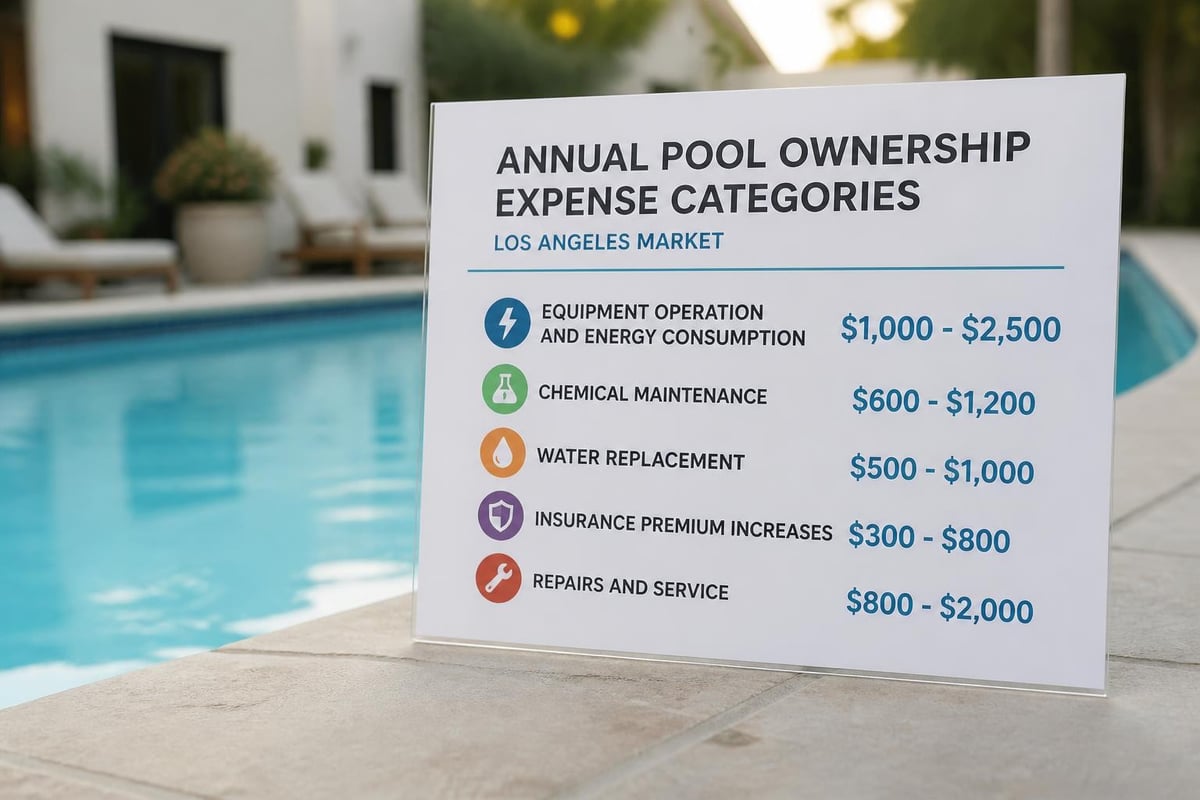
Premium increases vary by carrier and risk assessment but typically range from $25 to $75 monthly. Pool safety and insurance considerations outline how safety features like fencing, alarms, and covers can moderate these increases. Some insurers offer discounts for certified pool safety measures that exceed minimum code requirements.
Annual operating costs beyond insurance include:
- Electricity for pumps and heating ($600-$2,000)
- Chemicals and water testing supplies ($400-$800)
- Water to replace evaporation and backwashing ($100-$300)
- Equipment maintenance and occasional repairs ($300-$600)
- Professional service contracts if not self-maintained ($1,200-$2,400)
These recurring expenses add $2,600 to $6,100 annually for typical pool ownership, representing an important consideration when evaluating total project affordability. Energy-efficient equipment selections reduce the electricity portion substantially.
Return on Investment and Property Value Impact
The relationship between pool construction costs and home value remains complex and market-dependent. While pools enhance lifestyle and enjoyment, they rarely deliver dollar-for-dollar return in resale scenarios. Real estate analysis suggests pools typically return 30-50% of construction costs in warm climates like Southern California.
Geographic location within Los Angeles significantly influences value perception. Pools in Studio City, Pacific Palisades, and other affluent communities where they're expected amenities maintain stronger value contribution than neighborhoods where they're uncommon. The market segment matters as well, with luxury homes benefiting more from resort-quality pools than entry-level properties.
Factors that maximize pool-related home value:
- Professional design that complements architectural style
- Quality construction with premium materials and finishes
- Proper proportion relative to lot size (not overwhelming small yards)
- Energy-efficient equipment reducing buyer operating concerns
- Excellent maintenance history demonstrating pride of ownership
Buyers increasingly scrutinize operating costs and maintenance requirements. Pools with modern variable-speed pumps, salt chlorination systems, and automated controls appeal more than dated equipment requiring constant attention and high energy consumption.
Hidden Costs and Budget Contingencies
Experienced pool builders recommend adding 10-20% contingency to initial cost for building swimming pool estimates. Unforeseen conditions emerge during excavation, design preferences evolve during construction, and municipal requirements sometimes exceed initial expectations.
Common unexpected expenses include:
- Rock or unsuitable soil requiring removal and import ($2,000-$10,000)
- Utility line relocation when conflicts discovered ($1,500-$5,000)
- Upgraded electrical service if existing panel lacks capacity ($2,000-$6,000)
- Additional drainage solutions for water table management ($1,500-$4,000)
- Permit revision fees when design modifications occur ($500-$2,000)
Access limitations create cost premiums many homeowners overlook. Narrow side yards preventing large equipment access increase labor hours substantially. Properties requiring crane placement for equipment delivery add $1,500-$3,000 in specialized logistics costs. Detailed site evaluation during the planning phase identifies these factors before they become budget-breaking surprises.
Working with Licensed Contractors
Selecting a qualified, licensed pool builder protects your investment and ensures code compliance throughout construction. California requires pool contractors to hold appropriate licensing through the Contractors State License Board. Verify license status, bonding, and insurance coverage before signing contracts or depositing funds.
Quality contractors provide detailed written estimates breaking down labor, materials, equipment, and specific allowances for finish selections. Vague lump-sum proposals without itemization make cost comparison difficult and leave room for misunderstandings during construction.
Critical contractor evaluation criteria:
- Active contractor license in good standing (verify at CSLB.ca.gov)
- Workers compensation and liability insurance documentation
- References from recent projects of similar scope
- Written warranties on workmanship and equipment
- Clear payment schedule tied to construction milestones
Working directly with licensed general contractors specializing in pools streamlines communication and accountability. Family-owned operations often provide personalized attention and direct owner involvement that larger commercial builders cannot match.
| Contractor Type | Typical Advantage | Potential Drawback |
|---|---|---|
| Large commercial firm | Established systems, multiple crews | Less personal attention, higher overhead |
| Mid-size specialist | Balance of capacity and service | May have seasonal availability limits |
| Small family operation | Direct owner involvement, flexibility | Capacity limitations on multiple projects |
| Design-build firm | Integrated design and construction | Premium pricing for design services |
Seasonal Timing and Market Conditions
Construction timing affects both cost and project duration. The cost for building swimming pool can vary by 10-15% based on demand cycles and weather considerations. Los Angeles enjoys year-round construction weather, but spring and summer bring peak demand that sometimes inflates labor rates and extends contractor scheduling timelines.
Optimal timing considerations include:
- Fall and winter bookings often receive better pricing and attention
- Spring completion allows full summer enjoyment in inaugural season
- Permitting timelines (6-12 weeks) should precede desired construction start
- Equipment and material availability rarely affects gunite pool projects
- Contractor availability varies more than material costs in LA market
Rush fees for expedited timelines can add 15-20% to standard pricing. Planning your project 4-6 months ahead provides contractors reasonable scheduling flexibility and avoids premium charges for compressed construction windows. Building during the shoulder seasons often delivers better value without sacrificing quality or extending timelines into unfavorable weather.
Understanding the complete cost for building swimming pool empowers you to plan confidently and make informed decisions that balance dream features with financial reality. From initial excavation through final inspection, every choice affects both immediate investment and long-term satisfaction. AM Builds Inc. brings 15+ years of experience designing and building custom in-ground pools throughout Los Angeles, providing clear pricing, direct owner involvement, and meticulous attention to detail from concept through completion. Our licensed, family-owned team handles permits, engineering, construction, and finishing with transparent communication and clean job sites. Contact AM BUILDS CA at (424) 485-4548 for a free, no-obligation estimate tailored to your backyard vision and budget.


